
Is Squash Good for Weight Loss and Fitness?
Table of Contents
Is Squash Good for Weight Loss and Fitness? The Short Answer
Squash Calorie Burn Per Hour: What the Numbers Look Like
Calorie Burn by Session Type and Intensity
Cardiovascular and Muscular Benefits of Playing Squash
Heart Health, Endurance and Stress Relief
How Long Does It Take to Get Back Into Squash Fitness?
A Realistic 6-Week Return-to-Play Timeline
Beginner Squash Fitness Drills to Build Your Base
How Squash Compares to Other Racket Sports for Fat Loss
Injury Prevention and Equipment for Beginners
The warm-up that actually prevents injuries
A four-week starter program for beginners
Equipment: what you actually need to start
Frequently Asked Questions
Last Updated: September 29, 2026
Is Squash Good for Weight Loss and Fitness? The Short Answer
Yes, the question of is squash good for weight loss and fitness has a simple answer: it's one of the most physically demanding racket sports you can play. Squash combines high-intensity interval training with full-body movement, so you're burning calories while building cardiovascular endurance, agility and coordination at the same time.
Here's what most guides get wrong: they treat squash as either a weight-loss tool or a fitness tool, when the two go hand in hand. The stop-start rally structure pushes your heart rate into working zones, then lets it recover, then pushes it again. That pattern is why squash calorie burn per hour tends to sit well above steady-state jogging.
Below, we'll show you exactly what the numbers look like, how long it takes to get back into squash fitness, and the drills that build your base without wrecking your knees.
Squash Calorie Burn Per Hour: What the Numbers Look Like
The average person burns roughly 600 to 1,000 calories per hour playing squash, depending on body weight, intensity and how long rallies run. Heavier players and harder sessions sit at the top of that range; social hit-and-giggle games sit lower.
A useful way to think about it: squash is an anaerobic exercise with aerobic recovery. You're not jogging at a steady pace for an hour, you're sprinting to the front wall, lunging, recovering, and doing it again. That's why the Better Health Channel's physical activity guidelines recommend a mix of vigorous and moderate activity each week, and squash delivers both in a single session.
Calorie Burn by Session Type and Intensity
Session Type | Typical Duration | Intensity | Approx. Calorie Burn |
Social hit with mates | 45 min | Light | 300-450 |
Club match play | 60 min | Moderate | 550-750 |
Competitive training | 60 min | High | 750-1,000 |
Solo drills and ghosting | 30 min | Moderate | 250-400 |
Pro Tip The single biggest lever on squash calorie burn per hour isn't how hard you hit the ball, it's how little you stand still. Shorten your rest between rallies and you'll lift the burn without adding a minute to your session.
Cardiovascular and Muscular Benefits of Playing Squash
Squash improves both your heart health and your muscular endurance, and it does so faster than most gym routines because every rally demands a response. Your heart rate climbs into higher zones within seconds, then drops during the walk-back, then climbs again. Over weeks, that pattern raises your anaerobic threshold and your overall cardiovascular endurance.
Heart Health, Endurance and Stress Relief
The cardiovascular payoff is the headline. Regular squash play strengthens the heart, improves circulation and helps lower resting blood pressure over time. The Heart Foundation's guidance on physical activity notes that vigorous activity is particularly effective for heart health when built into a consistent weekly routine.
Muscular benefits come from the constant lunging, twisting and reaching. Squash builds muscle hypertrophy in the legs, glutes and core, though not in the bulk-building way a weights program does. Think tone and strength rather than size.
Then there's the mental side.
How Long Does It Take to Get Back Into Squash Fitness?
Most players returning after a long break need about six weeks of consistent play to feel genuinely match-fit again. The first two weeks are humbling. The next four are where the fitness comes back.
A Realistic 6-Week Return-to-Play Timeline
Weeks 1-2: Two short sessions per week, 30 minutes each. Focus on movement, not winning rallies.
Weeks 3-4: Three sessions per week, 45 minutes. Add structured drills and one longer match.
Weeks 5-6: Three to four sessions per week, 60 minutes. Introduce competitive match play and interval work.
A common mistake is jumping straight back into full-length matches in week one. That's how you pull a calf or tweak a hamstring. The Sports Medicine Australia injury prevention resources consistently emphasise graded return to load for exactly this reason.
Watch Out Skipping the warm-up is the fastest way to a soft-tissue injury in your first month back. Five minutes of light movement and dynamic stretching before you step on court isn't optional, and the cost of ignoring it is usually two to four weeks on the sideline.
Beginner Squash Fitness Drills to Build Your Base
The best beginner squash fitness drills are the ones that mimic match movement without the ball. Ghosting, court sprints and solo hitting build your base faster than playing games will, because you control the pace.

Start with these three:
Ghosting: Move to each of the four corners in sequence, shadow-swinging at each. Three sets of 60 seconds.
Court sprints: Sprint front wall to back wall and back. Six to eight reps with full recovery.
Solo hitting: Hit straight drives to yourself, alternating sides. Ten minutes continuous.
How Squash Compares to Other Racket Sports for Fat Loss
Squash burns more calories per hour than tennis, badminton or table tennis, and the reason is structural rather than a matter of effort. The court is enclosed, the ball is always live, and there is no walking to retrieve balls or waiting for a serve. That density of movement is what separates squash from the other racket sports on a per-minute basis.
Sport | Typical work-to-rest ratio | Movement density | Approx. calorie burn per hour |
Squash | 1:1 to 2:1 | Very high, enclosed court, continuous retrieval | 600-1,000 |
Tennis (singles) | 1:2 to 1:3 | Moderate, change of ends, ball retrieval | 450-700 |
Badminton (singles) | 1:1 to 1:2 | High but shorter court distances | 400-650 |
Table tennis | 1:3 or lower | Low, small court, short bursts | 200-350 |
Key Takeaway For fat loss, intensity beats duration. A hard 45-minute squash session will out-burn a casual 90-minute hit every time, and it's easier to fit into a busy week.
Injury Prevention and Equipment for Beginners
Injury prevention comes down to three things: proper footwear, a graded warm-up, and load management in your first month. Squash involves rapid direction changes, deep lunges and repeated twisting, so your ankles, knees, lower back and shoulders take the load. The sport is not inherently dangerous, but it punishes players who skip preparation, particularly those returning after years off or starting in middle age.
The warm-up that actually prevents injuries
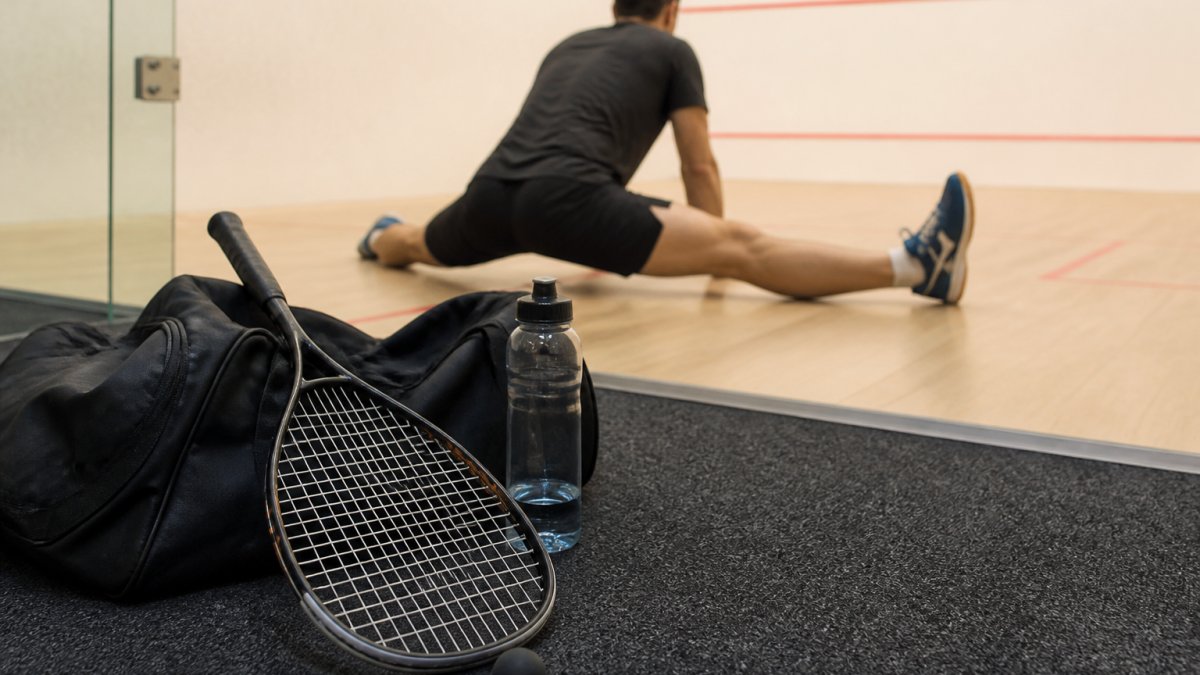
A five-minute warm-up is not optional. The most effective pattern for squash combines raising your heart rate, mobilising the joints you are about to load, and rehearsing the movement patterns at low intensity:
Two minutes of light movement, jogging on the spot, side-shuffles or skipping to raise core temperature.
Dynamic stretching, leg swings front-to-back and side-to-side, walking lunges, hip circles and arm circles. Hold nothing static before you play; save static stretches for after.
Ghosting at half pace, two minutes moving to the four corners without a ball, focusing on footwork and lunging mechanics.
A four-week starter program for beginners
Most guides offer anecdotes. This is a structured pathway you can follow without a coach, designed to build your base before you start playing full matches:
Week | Sessions | Session focus | Duration |
1 | 2 | Ghosting and solo hitting, no matches | 30 min |
2 | 2-3 | Add court sprints and one short social game | 35-40 min |
3 | 3 | Structured drills plus one club match | 45 min |
4 | 3-4 | Full sessions with match play and interval work | 50-60 min |
Equipment: what you actually need to start
Court shoes with non-marking soles and good lateral support, this is the single most important purchase. Running shoes lack the lateral stability squash demands and are a common cause of rolled ankles.
Eye protection for anyone playing competitively or in a busy court area. Squash balls travel fast and the risk is real.
A racquet matched to your level, not the lightest one on the shelf. Beginner racquets are typically heavier and more forgiving; lightweight frames suit advanced players with developed technique.
Comfortable, breathable clothing you can move freely in. There is no need for specialist apparel beyond that.
Best For Players returning after years off who want to rebuild fitness without joining a gym or committing to a fixed weekly schedule.
The thing nobody tells you about squash is that the court itself is the hardest part. It rewards players who can move efficiently, not just hit hard. Spend your first month learning to move, warming up properly and building load gradually, and the fitness follows without the injuries that derail most beginners.
Frequently Asked Questions
Does playing squash help with weight loss?
Yes. Squash is a high-intensity, full-body workout that burns more calories per hour than most racket sports. A 70 kg player can burn roughly 700 to 1,000 calories in a hard one-hour session, depending on rally length and rest periods. Combined with a sensible diet, three sessions per week creates the calorie deficit needed for steady fat loss.
How many calories can you burn in a one-hour squash session?
Calorie burn depends on body weight, rally intensity and rest time. As a guide, a 60 kg player burns around 600 to 850 calories per hour, a 75 kg player around 750 to 1,050, and a 90 kg player around 900 to 1,250. Casual social games sit at the lower end, while competitive match play pushes you toward the higher figures.
Is squash considered a high-intensity interval training (HIIT) workout?
In practice, yes. Squash naturally alternates short bursts of all-out movement with brief recovery between rallies, which mirrors the structure of high-intensity interval training. That pattern lifts your heart rate into higher zones, raises your metabolic rate, and keeps you burning calories after you leave the court. It is one reason squash is so time-efficient for weight management.
How does squash compare to other racket sports for fitness?
Squash typically burns more calories per hour than tennis, badminton or table tennis because rallies are continuous and the court is enclosed, so the ball rarely goes out of play. It also builds agility, coordination and anaerobic endurance faster than most racket sports. For fat loss in a short session, squash offers one of the strongest returns per minute played.
Book Online

Comments