
Get Back Into Squash After 40: A Safe Return Guide
Table of Contents
Why Returning to Squash After 40 Requires a Different Approach
Best Squash Warm-Up Routine for Over 40s
The RAMP Principle for Older Players
Mobility Work Before Court Time
Squash Injury Prevention for Masters Players
Common Injuries and How to Avoid Them
Lower Body Strength and Tendon Health
Building Physical Conditioning Gradually
Week-by-Week Return to Intensity
Aerobic Capacity and Anaerobic Training
Recovery Time and Active Recovery Strategies
Alternatives to Squash for Low-Impact Exercise
Equipment Selection and Court Movement Fundamentals
Tactical Adjustments and Match Play for Masters Players
Frequently Asked Questions
Last Updated: September 25, 2026
Why Returning to Squash After 40 Requires a Different Approach
When you get back into squash after 40, it's different from picking up the sport in your twenties. Your body has changed. Recovery takes longer. Injury risk is real. But returning to squash after 40 is absolutely achievable with the right approach.
The biggest mistake older players make is jumping back in at full intensity. They remember how they used to play and expect their body to cooperate immediately. It won't. Instead, a gradual, structured return prevents injury and builds sustainable fitness.
Your bones, tendons, and joints need time to adapt to impact loading. Your cardiovascular system needs rebuilding. Your court movement and tactical awareness may need refreshing. This guide covers all three, the physical conditioning, the injury prevention, and the on-court adjustments that make returning to squash after 40 realistic and enjoyable.

Best Squash Warm-Up Routine for Over 40s
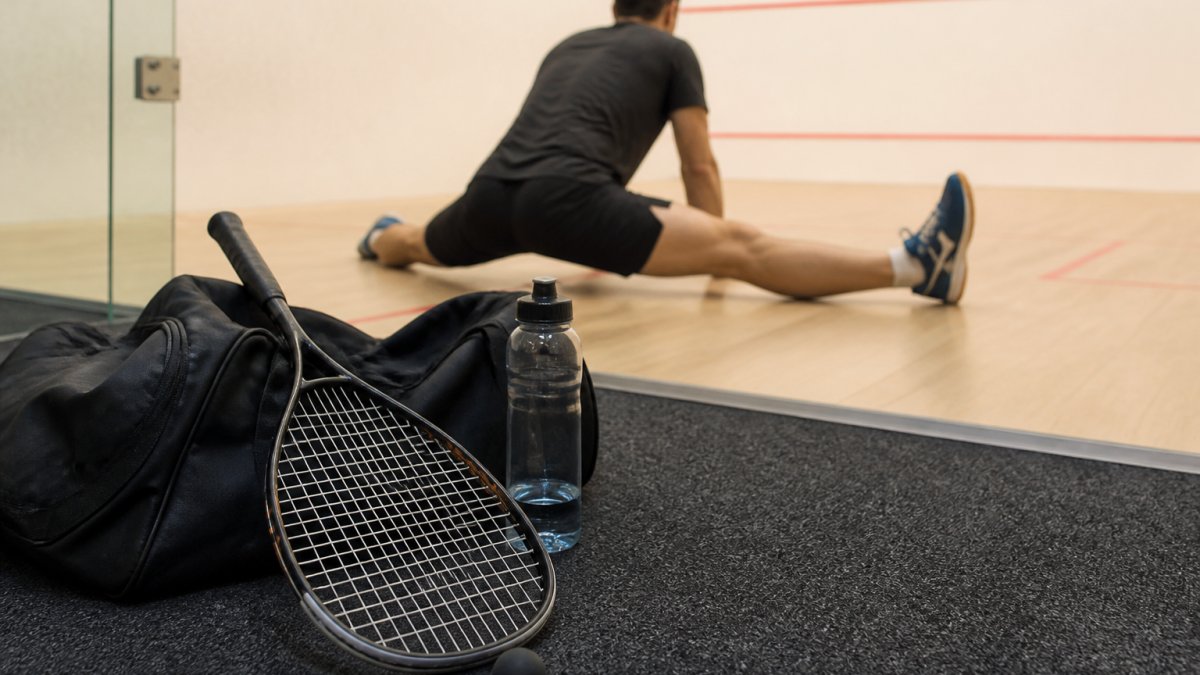
A proper warm-up is non-negotiable for players over 40. It prepares your muscles, activates your nervous system, and signals to your joints that impact is coming. Skip it and you're asking for injury.
The best squash warm-up routine for over 40s follows the RAMP principle: raise, activate, mobilise, perform.
The RAMP Principle for Older Players
Raise your heart rate first. Five minutes of light cardio, jogging on the spot, walking briskly, or easy cycling, gets blood flowing without demanding much from your joints. You should feel warm but not exhausted.
Activate your stabilising muscles next. These small muscles support your larger ones during explosive movement. Bodyweight squats, glute bridges, and scapular push-ups wake them up. Do 10-15 reps of each, slowly.
Mobilise your joints through their full range of motion. Arm circles, hip circles, and torso rotations prepare your body for the demands ahead. Spend 2-3 minutes here. This is where age matters most, your mobility naturally declines, so don't rush.
Perform your sport-specific movement last. Hit some gentle shots, move around the court without intensity, and build up your rhythm. This is your transition from warm-up to match play.
Mobility Work Before Court Time
Mobility work is the difference between a player who can move fluidly and one who moves stiffly. After 40, your flexibility declines naturally. Mobility work slows that decline and keeps you moving like a player.
Focus on these key areas:
Hip mobility: Your hips control your court movement. Lunges, leg swings, and pigeon pose open them up. Spend 90 seconds here.
Shoulder mobility: Overhead shots demand shoulder range. Arm circles, cross-body shoulder stretches, and band pull-aparts prepare your shoulders. Two minutes minimum.
Ankle mobility: Your ankles absorb impact. Ankle circles, calf stretches, and gentle side-to-side movement build stability. One minute.
Spine mobility: Rotation and flexion matter on court. Cat-cow stretches and gentle twists prepare your spine. Two minutes.
Total mobility work: 6-8 minutes before you step on court. This time investment prevents injury and improves your movement quality dramatically.
Squash Injury Prevention for Masters Players
Injury prevention for masters players isn't about being cautious, it's about being smart. Most injuries happen because players don't respect the demands they're placing on their body.
SQUASHTV
Common Injuries and How to Avoid Them
The most common injuries for returning players are shoulder strains, lower back pain, and knee problems. These aren't inevitable.
Shoulder strain happens when you overuse your rotator cuff. Prevent it by strengthening your rotator cuff with light resistance band work twice weekly. Do external rotations, internal rotations, and band pull-aparts. Fifteen reps each, three times per week.
Lower back pain usually comes from poor court movement or inadequate core strength. Your core stabilises your spine during explosive movement. Planks, dead bugs, and bird dogs build that stability. Hold planks for 30-45 seconds, three times per week.
Knee problems develop when you increase intensity too quickly. Your knees absorb impact. Build lower body strength gradually. Squats and lunges strengthen the muscles that support your knees. Start with bodyweight, progress slowly.
Lower Body Strength and Tendon Health
Tendon health is overlooked but critical. Your tendons connect muscle to bone. After 40, they adapt more slowly to stress. Build strength gradually and your tendons adapt. Rush it and you risk tendinopathy.
Focus on these lower body exercises:
Squats: Build quad and glute strength. Start with bodyweight, progress to weighted squats. Three sets of 10-12 reps, twice weekly.
Lunges: Develop single-leg strength and balance. Forward, reverse, and lateral lunges all matter. Three sets of 8 reps per leg, twice weekly.
Calf raises: Strengthen your calves and improve ankle stability. Three sets of 12-15 reps, twice weekly.
Step-ups: Build functional leg strength. Use a step or low bench. Three sets of 10 reps per leg, twice weekly.
Do this work on non-court days. Your body needs recovery between strength training and court play.
Building Physical Conditioning Gradually
To get back into squash after 40 means rebuilding your aerobic capacity and anaerobic power. These energy systems took time to develop when you were younger. They take time now too.
Week-by-Week Return to Intensity
Weeks 1-2: Play twice weekly, 20-30 minutes per session. Keep intensity low. Focus on movement and technique, not winning points. Your goal is adaptation, not performance.
Weeks 3-4: Play twice weekly, 30-40 minutes per session. Introduce some moderate-intensity rallies. You should still be able to hold a conversation during play.
Weeks 5-6: Play twice or three times weekly, 40-50 minutes per session. Add some competitive play. You'll start to feel your aerobic capacity improving.
Weeks 7-8: Play three times weekly, 45-60 minutes per session. Include one higher-intensity session. Your body is adapting now.
Weeks 9+: Play three to four times weekly. Vary intensity, some days competitive, some days technical work. You've rebuilt your base.
Week Range | Sessions Per Week | Duration Per Session | Intensity Level |
Weeks 1-2 | 2 | 20-30 min | Low (movement focus) |
Weeks 3-4 | 2 | 30-40 min | Low-moderate |
Weeks 5-6 | 2-3 | 40-50 min | Moderate |
Weeks 7-8 | 3 | 45-60 min | Moderate-high |
Weeks 9+ | 3-4 | 45-60 min | Varied (mixed) |
Pro Tip Track how you feel, not just how you play. If you're sore for more than 24 hours after a session, you did too much. Adjust the next week accordingly.
Aerobic Capacity and Anaerobic Training
Aerobic capacity is your ability to sustain effort. Anaerobic power is your ability to produce short bursts of speed. You need both for squash.
Build aerobic capacity with longer, moderate-intensity sessions. Play for 45-60 minutes at a pace where you're working but not exhausted. This trains your heart to deliver oxygen efficiently.
Build anaerobic power with interval work. After you've built a base (weeks 5+), add one session per week with short bursts of intensity. Hit aggressive shots for 30 seconds, recover for 30 seconds, repeat for 10-12 rounds. This trains your energy systems to produce power quickly.
Do this work carefully. Anaerobic training is demanding. Start with just one session per week and only after you've built aerobic fitness.
Recovery Time and Active Recovery Strategies
Recovery is where improvement happens. Your body adapts during rest, not during play. Respect recovery and you'll progress. Ignore it and you'll stagnate or get injured.
Active recovery means moving gently on your non-court days. A 20-30 minute walk, easy swimming, or gentle cycling keeps blood flowing and promotes adaptation without adding stress.
Key Takeaway The single biggest recovery mistake is playing hard every day. Your body needs rest to adapt. Play hard 3-4 times per week, do active recovery the other days, and sleep well. That's the formula.
Alternatives to Squash for Low-Impact Exercise
If you need a break from squash but want to maintain fitness, low-impact alternatives preserve your conditioning without the joint stress.
Equipment Selection and Court Movement Fundamentals
Your equipment matters more now than when you were younger. The right racket reduces wrist strain. Proper shoes support your ankles. Good eyewear protects your eyes from the ball.
Tactical Adjustments and Match Play for Masters Players
Match play is where everything comes together. Your physical conditioning, injury prevention, and court movement all matter. But so does your tactical approach.
Frequently Asked Questions
Is it safe to start playing squash again in my 40s?
Yes, returning to squash after 40 is safe when you follow a structured approach. Start with a thorough warm-up using the RAMP principle, raise your heart rate, activate muscles, mobilise joints, then perform dynamic movements. Gradual conditioning over 4-6 weeks allows your cardiovascular system, bones, and tendons to adapt. Most injuries occur when players rush intensity or skip warm-ups. Consult your GP if you have existing joint or heart concerns before resuming regular play.
What are the most common injuries for squash players over 40?
Masters players most often experience shoulder rotator cuff strains, lower back pain, knee stress, and Achilles tendon issues. These occur due to reduced flexibility, declining bone density, and muscle power loss over time. Squash injury prevention for masters players requires consistent lower body strength work, adequate recovery time between matches, and proper technique during explosive movements like lunges and cross-court volleys. Address any pain immediately rather than pushing through it.
How often should I play squash to maintain fitness without overtraining?
Start with 1-2 sessions per week during your first month back, increasing to 2-3 sessions weekly once your body adapts. Include at least one rest day between matches to allow active recovery. Overtraining at 40+ accelerates joint wear and increases injury risk. Monitor your energy levels and performance, if you feel fatigued or sore beyond 48 hours after play, reduce frequency. Social squash with lower intensity counts as active recovery and keeps you engaged without excessive training load.
Do I need different equipment when returning to squash after a long break?
Your racket choice matters more than you might think. A heavier racket (around 140-150g) reduces the impact on your arm and shoulder, while a larger head size increases forgiveness on off-centre hits. Choose court shoes with good lateral support to protect your knees during quick directional changes. Wear moisture-wicking clothing to stay comfortable during longer rallies. Consult with a squash professional or specialist retailer for advice on racket selection based on your playing style and physical needs.
Book Online


Comments