
How to Play Squash After Years Away: A 2026 Guide
Table of Contents
What You'll Need Before Your First Session Back
How to Play Squash After Years: The Basic Rules Refresher
Squash Injury Prevention for Masters: Protecting a Body That Remembers
How Long Should You Play Squash For When You're Starting Again?
Solo Drills and Ghosting: Rebuilding Muscle Memory Without a Partner
Low Impact Exercise Alternatives to Squash for Recovery Days
Modern Equipment and Court Etiquette: What Has Changed
Frequently Asked Questions
Last Updated: September 27, 2026
What You'll Need Before Your First Session Back
Getting back on court after years away starts with the right gear and a realistic plan. You do not need much to play squash again.
Here is what to sort out first:
Non-marking shoes with good grip. Regular runners can mark the floor and most courts will turn you away.
A racquet you can actually swing. Borrow one before you buy.
A hollow rubber ball matched to your level. The blue dot ball is slower and easier to control than the competition ball.
Sports clothing you can move in. Nothing fancy.
Water and a towel. You will sweat more than you expect.
At Launceston Squash Centre, we see plenty of returning players walk in with old gear and big plans. The smart ones start slow.
Book a court at a quiet time for your first hit. Fewer people means less pressure and more space to find your feet.
How to Play Squash After Years: The Basic Rules Refresher
The rules have not changed much, but a few details have shifted since you last played, and those are the ones that catch returners out. Here is the short version, plus the bits that trip people up.
The court, in one line. Four walls, a front wall with a service line and a tin (the metal strip at the bottom), and two service boxes. The ball must hit the front wall above the tin on every shot. If it hits the tin, the rally is over.
Scoring. A standard game goes to 11 points, point-a-rally (PAR), and you must win by two clear points. So 10-10 goes to 12-10, 13-11, and so on. Best of five games is the standard match format. This is the same as it has been for years, so nothing to relearn there.
Serving. You stand in a service box, one foot inside the box, and hit the ball to the front wall above the service line. The ball must land in the opposite quarter of the court after it bounces. You get one serve, not two. If you win the rally, you serve again from the other box.
The shots you will actually use.
Straight drive, down the wall, low and tight. Your bread-and-butter shot and the safest option when you are rusty.
Cross-court, diagonal to the opposite back corner. Buys you time to recover to the T.
Drop shot, soft, into the front corner. Only useful once you can control it.
Boast, off the side wall to the front wall. A defensive escape, not a winner.
Volley, hitting the ball before it bounces. The single biggest time-saver on court, and the shot most returners forget they can play.
Let vs stroke, the bit returners get wrong.
A let is called when there is interference but no clear advantage was lost. The rally is replayed.
A stroke is awarded when your opponent blocks a shot that would have been a clear winner, or when they fail to clear after playing. You win the point.
You can also call a let if you hit your opponent with the ball, or if the ball hits them before it reaches the front wall.
The 2024 rule updates worth knowing. The World Squash Federation updated the rules in 2024. The two changes most relevant to club players are tighter definitions around what counts as a reasonable swing and clearer guidance on when a let is played rather than awarded. In practice, this means fewer soft lets and more strokes for genuine blocking. If you have not played since before 2024, expect the calls to feel slightly stricter than you remember.
The ball. The double yellow dot is the standard competition ball. It is slow, it barely bounces when cold, and it is the wrong ball for a returner. Start with a blue dot, which is noticeably bouncier and gives you time to reach the ball. Move to a red dot, then a double yellow, as your timing and fitness return. Playing with a double yellow in week one is the fastest way to feel like you have never held a racquet.
Court positioning. After every shot, move back toward the T in the centre of the court.
Pro Tip If you only remember one thing from this section, remember the T. Everything else in squash is downstream of being in the right place at the right time.
Squash Injury Prevention for Masters: Protecting a Body That Remembers
Squash injury prevention for masters players comes down to one thing: your muscles remember the game, but your tendons and joints do not. That gap is where injuries happen.
SQUASHTV
Watch out for these common mistakes:
Skipping the warm-up because you "used to be fine"
Lunging too deep too early in a session
Playing three hard games in your first week back
Ignoring small aches that turn into bigger problems
How Long Should You Play Squash For When You're Starting Again?
How long should you play squash for as a returning player? Aim for 30 to 40 minutes of light hitting for your first few sessions. Build up slowly over several weeks.
A sensible first month looks like this:
Week | Session Length | Frequency | Focus |
Week 1 | 30 minutes | Twice | Light rallies, movement |
Week 2 | 40 minutes | Twice | Longer rallies, ghosting |
Week 3 | 45 minutes | Three times | Match play, drills |
Week 4 | 60 minutes | Three times | Full games, strategy |
Solo Drills and Ghosting: Rebuilding Muscle Memory Without a Partner
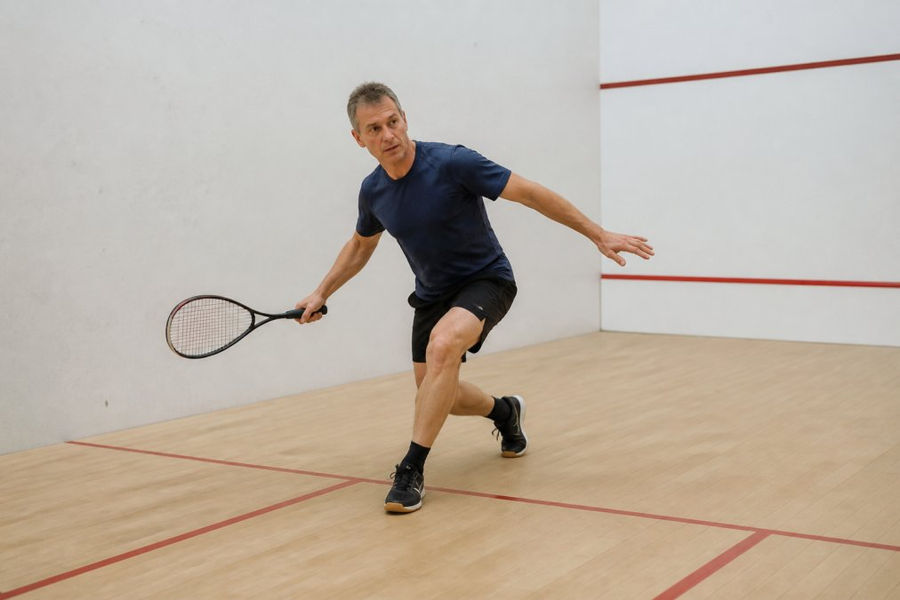
Solo drills are the fastest way to rebuild muscle memory, and you do not need a partner to do them. Ghosting and solo hitting will bring your game back quicker than match play alone.
Try these drills:
Ghosting: Move to each corner and back to the t-position without a ball. Do six rounds.
Straight drives: Hit the ball down the wall from the backcourt, over and over.
Cross-court rallies: Alternate sides to work your swing mechanics.
Drop shots: Practise soft touches from the front of the court.
Low Impact Exercise Alternatives to Squash for Recovery Days
Most squash content tells you to cross-train. Almost none of it explains why squash beats up a returning body in specific ways, or what to do about it. That is the gap this section fills.
What squash actually does to you. A squash rally is a series of short, explosive lunges, twists, and direction changes, repeated for 20 to 60 seconds at a time. The load lands hardest on:
Knees and ankles, from deep lunges and rapid deceleration.
Achilles tendons, from repeated push-offs, especially when cold.
Lower back, from twisting under load during backhand shots.
Shoulders, from the repetitive overhead and side-arm swing.
The recovery-day menu, with dosage.
Activity | Why it helps squash | Suggested dose |
Swimming | Zero impact, full-body, opens the shoulders | 20-30 min, easy pace |
Cycling (stationary or road) | Builds leg endurance without knee load | 30-45 min, conversational pace |
Walking | Flushes the legs, low stress | 30-60 min |
Yoga or mobility | Restores hip and ankle range lost to sitting | 15-20 min, focus on hips and calves |
Rowing | Cardio with no ground impact | 15-20 min, steady state |
A sample week for a returner.
Mon: Squash, 30 min light hitting
Tue: Swim or walk, 30 min
Wed: Squash, 40 min drills
Thu: Cycle or yoga, 30 min
Fri: Rest or walk
Sat: Squash, 45 min match play
Sun: Rest or mobility
Watch Out If you have a history of Achilles, knee, or lower-back issues, get a physiotherapist's clearance before you start. Squash is one of the most joint-demanding racquet sports, and a returner's first month is when most avoidable injuries happen.
Modern Equipment and Court Etiquette: What Has Changed
Racquets have changed a lot since you last played. Modern frames are lighter, and the sweet spot is bigger. That means less effort for more power.
Court etiquette still matters:
Call your own lets and strokes honestly
Wear non-marking shoes, always
Give your opponent room to play their shot
Shake hands after the match
Frequently Asked Questions
How can I prevent injury when returning to squash after years?
Warm up for at least 10 minutes with dynamic stretches, focusing on hips, calves, and shoulders. Wear non-marking shoes with good lateral support. Start with 20-minute sessions and increase gradually. Listen to your body: if a joint feels unstable, stop. Consider a physio assessment before your first game to check for imbalances from years of inactivity.
How long should a typical squash session be for a returning player?
Start with 20 to 30 minutes of light hitting and drills, three times a week. After two weeks, extend to 40 minutes. A full match can wait until week four or five. The goal is consistency over intensity. If you can talk while playing, you are at the right pace. Stop before you are exhausted, not after.
What equipment upgrades should I consider after a long break?
Racquets have changed: modern frames are lighter and more forgiving. A mid-weight racquet with a larger head size helps on off-centre hits. Replace old shoes, as midsole cushioning degrades. Use a hollow rubber ball suited to your level, not a competition ball. Goggles are now standard for eye safety in many clubs.
Are there low impact exercise alternatives to squash for recovery days?
Swimming, cycling, and rowing build cardiovascular endurance without stressing knees and ankles. Yoga and pilates improve flexibility and core strength, which support court positioning. A 30-minute walk on recovery days keeps blood flowing. These options let you train daily without the joint load of squash, reducing injury risk while you rebuild fitness.
Getting back into squash after years away is a challenge, but it is one your body and mind can handle with the right approach. Start slow, drill solo, and pick a facility that fits your schedule rather than forcing your schedule around it. Launceston Squash Centre offers online booking, self-service entry through the SALTO app, and courts open from 6am to 11pm daily, so you can play when it suits you and focus on finding your game again. Book online and take that first session back.
Book Online

Comments