
Racquetball vs Squash for Beginners: Which to Try?
Table of Contents
Racquetball vs Squash at a Glance
Court Dimensions, Surfaces and Equipment Specifications
Ball Elasticity, Bounce and Warm-Up Demands
Racket and Racquet Size, Stringing and Swing Mechanics
Rules, Scoring Systems and Rally Length
Intensity, Physical Exertion and Fitness Metrics
How hard each sport feels
What that means for a beginner
Estimating your own burn
The fitness trade-off in one line
Injury Risk and Safety Gear
Eye injuries: the one risk that is not negotiable
Joint and soft-tissue injuries
Reducing your risk
Which is safer for a beginner?
Squash for Beginners Tips: Building Hand-Eye Coordination
Low Impact Racket Sports: Which Is Gentler?
Cost of Entry and Court Availability
Frequently Asked Questions
Last Updated: September 21, 2026
Racquetball vs Squash at a Glance
Choosing between racquetball and squash for beginners comes down to one question: do you want a fast, forgiving game or a slower, more technical one? This guide from Launceston Squash Centre breaks down the differences so you can pick the right court sport for your goals.
Both are indoor racket sports played in enclosed courts. Both will get your heart rate up. But the equipment, the rules, and how quickly you can hold a rally are genuinely different. Below, we'll show you exactly how they compare, from ball bounce to injury risk, so you can decide which one suits you.

Feature | Racquetball | Squash |
Ball bounce | High, lively | Low, requires warm-up |
Racket length | Up to 55 cm | Up to 68 cm |
Court size | Larger | Smaller |
Rally length | Longer for beginners | Shorter initially |
Learning curve | Gentler | Steeper |
Best for | Fast fun, quick rallies | Precision, fitness |
Court Dimensions, Surfaces and Equipment Specifications
Racquetball courts are larger and four-walled, while squash courts are narrower with a front wall and a tin at the base. The court surface for both is typically polished wood or a synthetic composite, and both are enclosed, so the ball stays in play.
A standard squash court is 9.75 metres long and 6.4 metres wide. A racquetball court is roughly 12.2 metres long and 6.1 metres wide, with a higher ceiling. That extra space matters: it gives beginners more time to react, which is why rallies tend to last longer early on.
Ball Elasticity, Bounce and Warm-Up Demands
Ball elasticity is the biggest practical difference. A racquetball is larger, softer, and bounces high off the walls with minimal effort. A squash ball is smaller, denser, and barely bounces until it is warmed up through repeated hitting.
That warm-up demand trips up a lot of beginners. The standard squash ball needs several minutes of hard hitting before it behaves. A common mistake is buying the professional-grade double yellow dot ball straight away and then wondering why nothing bounces. Start with a beginner ball that is livelier, then move up as your control improves.
Racket and Racquet Size, Stringing and Swing Mechanics
Squash rackets are longer and lighter, with a smaller head. Racquetball rackets are shorter, with a larger head and a bigger sweet spot. Squash stringing is tighter for control; racquetball stringing is looser for power.
The swing mechanics differ too. Squash rewards a compact, wristy swing with tight control. Racquetball lets you take a fuller swing because the ball travels further. If you're new to both, the shorter racquetball racket is more forgiving while you build hand-eye coordination.
Rules, Scoring Systems and Rally Length
Squash uses a point-a-rally scoring system to 11, while racquetball typically plays to 15. In both, you serve from a service box and the ball must hit the front wall before the floor. The main rules difference is the tin: squash has a low metal strip at the base of the front wall that ends the rally if you hit it.
Sports Genie
Rally length is where racquetball wins for beginners.
Intensity, Physical Exertion and Fitness Metrics
Most comparison articles stop at 'both are a good workout'. That is not useful if you are choosing a sport to get fit. Here is what actually differs, and how to use it.
How hard each sport feels
Squash is typically played at a higher average intensity than racquetball. The smaller court and lower-bouncing ball force shorter, sharper movements, you are never far from the ball, so the rally rarely slows down. Racquetball has a larger court and a livelier ball, which means longer distances covered but more glide between shots.
A useful way to think about it:
Squash behaves like repeated short sprints with quick recovery. Heart rate spikes hard, drops, spikes again.
Racquetball behaves more like a sustained jog with bursts. Heart rate stays elevated for longer stretches.
What that means for a beginner
If you are new and unfit, racquetball is usually the easier on-ramp because the ball does more of the work. You can hold a rally without perfect movement. Squash punishes poor positioning faster, you will lunge more, change direction more, and feel it in your legs the next day.
Estimating your own burn
Rather than quote a single calorie figure (which varies enormously with body weight, rally length and effort), use this rule of thumb:
A 30-minute beginner session in either sport will typically sit in the moderate-to-vigorous range.
Squash sessions tend to sit at the higher end of that range per minute played.
Racquetball sessions tend to accumulate more total active minutes because rallies last longer.
The fitness trade-off in one line
Squash gives you more intensity per minute. Racquetball gives you more minutes of intensity. For most beginners, racquetball is easier to sustain; squash is easier to progress with once your movement improves.
Key Takeaway Pick racquetball if you want to be moving continuously from session one. Pick squash if you want a sharper, stop-start burn and are willing to build the movement skills to handle it.
Injury Risk and Safety Gear
Beginners ask a simple question: which one is more likely to hurt me? The honest answer is that the two sports injure people in different ways, and the risks are manageable in both.
Eye injuries: the one risk that is not negotiable
Both sports involve a small ball moving fast in an enclosed space, and both carry a real risk of eye injury. Squash balls are smaller and denser; racquetball balls are larger and faster off the wall. Neither is safe to play without eye protection.
Joint and soft-tissue injuries
The injury profiles differ in a predictable way:
Squash loads the knees, ankles and lower back through repeated lunging and deep court coverage. Beginners who have not built leg strength often feel it in the knees first.
Racquetball loads the shoulders, elbows and wrists more, because the fuller swing and faster ball encourage harder hitting. Beginners often feel it in the shoulder or elbow first.
In both sports, the most common acute injuries are ankle rolls from sudden direction changes and muscle strains from cold starts.
Reducing your risk
A few habits cut most of the risk:
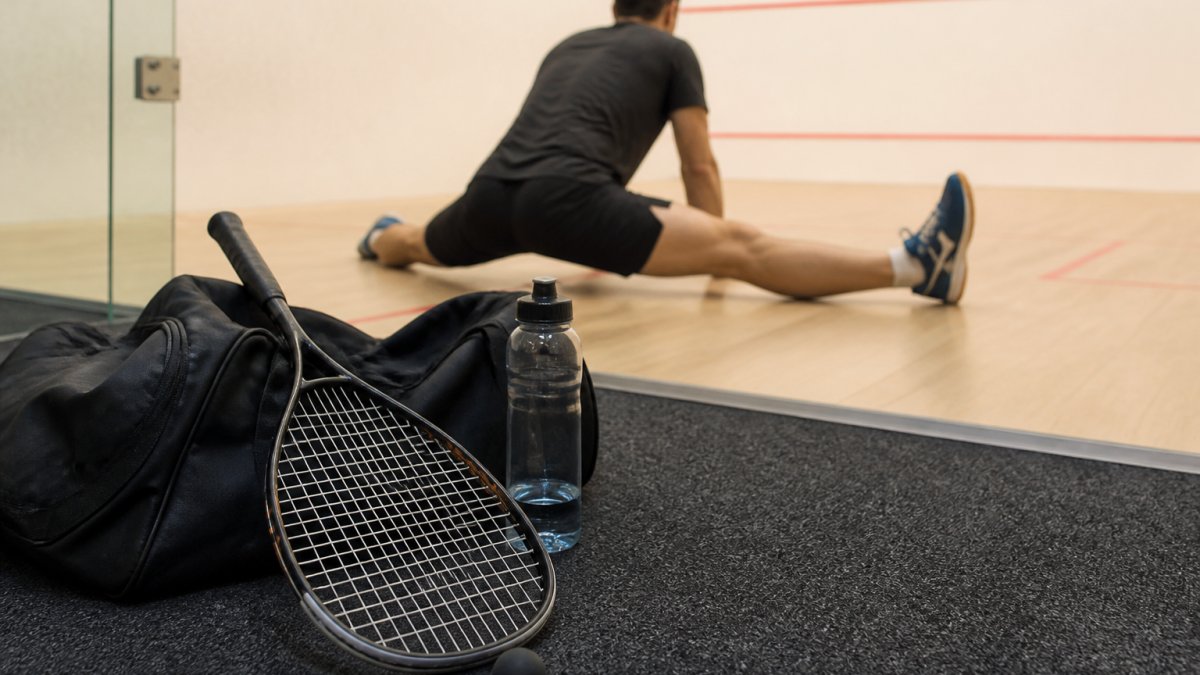
Warm up for at least five to ten minutes before your first rally, light movement, then progressive hitting.
Wear proper indoor court shoes with good lateral support. Running shoes are not a substitute.
Build up session length gradually. Twenty minutes is plenty for the first few weeks.
For squash, start with a livelier beginner ball so you are not over-swinging to compensate for a dead ball.
For racquetball, check your grip size, too small a grip encourages over-gripping and elbow strain.
Which is safer for a beginner?
There is no absolute answer, but the pattern is consistent: squash tends to be harder on the lower body, racquetball on the upper body. If you have a history of knee or ankle problems, racquetball's more upright movement may suit you better. If you have shoulder or elbow issues, squash's compact swing may be kinder.
Watch Out Do not skip eye protection because the ball 'looks soft'. Both squash and racquetball balls are hard enough to cause serious eye damage at match speed.
Squash for Beginners Tips: Building Hand-Eye Coordination
Squash rewards patience. The best squash for beginners tips all point to the same thing: build hand-eye coordination before you chase power. Start with a livelier ball, keep your racket up, and watch the ball onto the strings.
Watch Out Don't buy a professional-grade squash ball as your first ball. It won't bounce properly until it's warm, so beginners end up swinging harder to compensate, which wrecks their technique.
Low Impact Racket Sports: Which Is Gentler?
If low impact racket sports are your priority, squash can be a gentler option on the joints for some players. The softer ball and slower pace can mean less pounding, and the smaller court can mean fewer long sprints.
Cost of Entry and Court Availability
Getting started in either sport is affordable. A basic racket starts at a modest outlay, and a ball costs very little. The bigger variable is court access and how often you want to play.
Frequently Asked Questions
Which is easier for a beginner to learn, squash or racquetball?
Racquetball is usually the quicker sport to pick up. The larger ball bounces more predictably and the shorter racket is easier to control, so rallies last longer from your first session. Squash demands more precise swing mechanics and a ball that needs warming up before it bounces properly. Most beginners see a workable squash rally only after a few sessions of focused practice.
Is racquetball considered a low impact alternative to squash?
Neither sport is truly low impact because both involve lunging, twisting and quick direction changes. Racquetball rallies can be shorter and more explosive, while squash can involve longer continuous movement. Players wanting lower joint stress should warm up thoroughly, wear supportive court shoes and build rally length gradually rather than jumping straight into competitive play.
How do the court sizes differ between squash and racquetball?
A standard squash court measures 9.75 metres long and 6.4 metres wide. A racquetball court is roughly 12.2 metres long and 6.1 metres wide, with a higher ceiling. The tighter squash space rewards control, while the racquetball court suits a faster, more reflex-driven game.
What are the main equipment differences between squash and racquetball?
Squash uses a small, hollow rubber ball and a racket up to 68.6 centimetres long with a maximum head width of 21.5 centimetres. Racquetball uses a larger, bouncier ball and a shorter racket capped at 55.9 centimetres. Beginners should also budget for non-marking court shoes and eye protection, which is mandatory in competitive racquetball.
Racquetball and squash both offer a great workout, but the right pick depends on whether you want fast rallies or a technical challenge. Either way, regular court access makes the difference between trying it once and actually improving. Launceston Squash Centre offers online booking, self-service entry via the SALTO app, and flexible membership options so you can play on your own schedule. Get started with Launceston Squash Centre and find your game.
Book Online

Comments