
Beginner Racquetball Lessons: Your First Steps
Last Updated: October 22, 2026
Quick Summary
Beginner racquetball lessons in Launceston are best found by contacting facilities with dedicated racquetball courts directly and asking whether they offer coaching or can refer you to an instructor. If formal lessons are unavailable, ask whether a staff coach can run a single introductory session covering grip, serve, and court positioning.
Call facilities rather than email to get a definitive answer about lesson availability from the coach on duty.
Ask three specific questions: whether courts are marked for racquetball, if a coach teaches beginners, and whether lessons are one-to-one or group format.
At Launceston Squash Centre, courts can be booked online with a smartphone key and are available 6am to 11pm daily.
Book the court and coach separately, as they are usually handled through different channels and confirmed independently.
Start with a single trial lesson or introductory session rather than committing to a full term.
Table of Contents
How to Find Beginner Racquetball Lessons Nearby
Start with facilities that have racquetball courts
Use the booking system as a research tool
Ask about introductory or trial formats
Widen the search to related racquet sports
What to expect when you do find a coach
Understanding Racquetball Rules for Beginners
Essential Racquetball Equipment for Beginners
What to Bring to Your First Lesson
Racquetball Drills for Beginners to Build Confidence
Creating a Racquetball Practice Plan
Booking Your First Session and Joining
Booking the court
Booking the coach
Understanding the cost structure
Membership versus casual play
If formal lessons are not available
Arriving for your first session
Frequently Asked Questions
How to Find Beginner Racquetball Lessons Nearby
Most searches for beginner racquetball lessons return tennis sign-in pages and general sports directories, not verified racquetball instruction. In Launceston, racquetball coaching is not advertised as a standalone product the way tennis or squash coaching is. Start with facilities that have racquetball-marked courts and ask directly whether they run beginner instruction or can refer you to a coach who does.
Start with facilities that have racquetball courts
Racquetball and squash share court dimensions and wall markings closely enough that many venues host both. A facility with dedicated racquetball courts is the most likely place to find a coach, because the coach needs regular court access. When you call, ask three specific questions rather than a general 'do you do lessons?':
Do you have courts marked for racquetball (not just squash)?
Is there a coach on staff or a regular instructor who teaches beginners?
Are lessons one-to-one, small group, or run as a short introductory course?
A 'yes' to the first question and a 'we can put you in touch with someone' to the second is a realistic outcome; a 'yes' to all three is ideal. A flat 'no' to the first question means move on.
Use the booking system as a research tool
Many venues run online booking portals or apps showing court types, availability, and sometimes instructor profiles. Check whether the system lists racquetball courts separately from squash courts, if so, the facility treats racquetball as distinct and is more likely to have coaching attached. If it only lists 'squash court', ask on the phone whether racquetball is permitted and whether any coach specialises in it.
Ask about introductory or trial formats
Because racquetball coaching is thin on the ground, the most realistic entry point is often a short introductory session rather than a full term. Ask about a one-off beginner session, trial lesson, or casual 'come and try' slot, these lower the commitment and let you confirm the coach's approach suits you. If no formal lesson exists, ask whether a staff coach can run a single 45-60 minute basics session covering grip, serve, and court positioning; many will, even unadvertised.
Widen the search to related racquet sports
If racquetball-specific coaching genuinely is not available, book a beginner squash or tennis lesson at a venue that also has racquetball courts. Footwork, swing mechanics, and court awareness transfer well, and a squash coach on the same court can walk you through racquetball differences in one session. Be explicit that you want to play racquetball so the coach tailors the session.
Pro Tip Call rather than email. Lesson availability at smaller venues is often decided by the coach on duty, and a two-minute phone call gets a definitive answer that an email may not.
What to expect when you do find a coach
Beginner racquetball instruction in a smaller market tends to be informal: one coach, a handful of courts, lessons arranged around the coach's other commitments. Expect questions about fitness and prior racquet-sport experience, and a first session focused on safety, grip, and the serve rather than rallying. If a venue cannot clearly answer on cost, duration, and what to bring, ask more questions before committing.
Understanding Racquetball Rules for Beginners
Racquetball is simpler than squash in structure but demands quick reflexes and court awareness: hit the ball against the front wall so your opponent cannot return it before it bounces twice on the floor.
The basic rules are these. The server stands in the service box and bounces the ball, then strikes it to the front wall. The ball must land in the service box on the rebound.
Beginners often struggle with the pace: racquetball is faster than squash because the ball travels at higher speeds on a smaller court, so decisions happen quickly.
Essential Racquetball Equipment for Beginners
You need surprisingly little to start playing racquetball, but what you do need must meet basic safety and performance standards.
A racquet is your primary tool. Beginner racquets are lighter and more forgiving, with larger hitting surfaces.
The ball matters more than many new players realise. Balls come in green (slow), blue (medium), and red (fast).
Protective eyewear is non-negotiable.
Court shoes with good lateral support are essential. Racquetball demands quick side-to-side movement, and regular trainers lack the ankle stability you need.
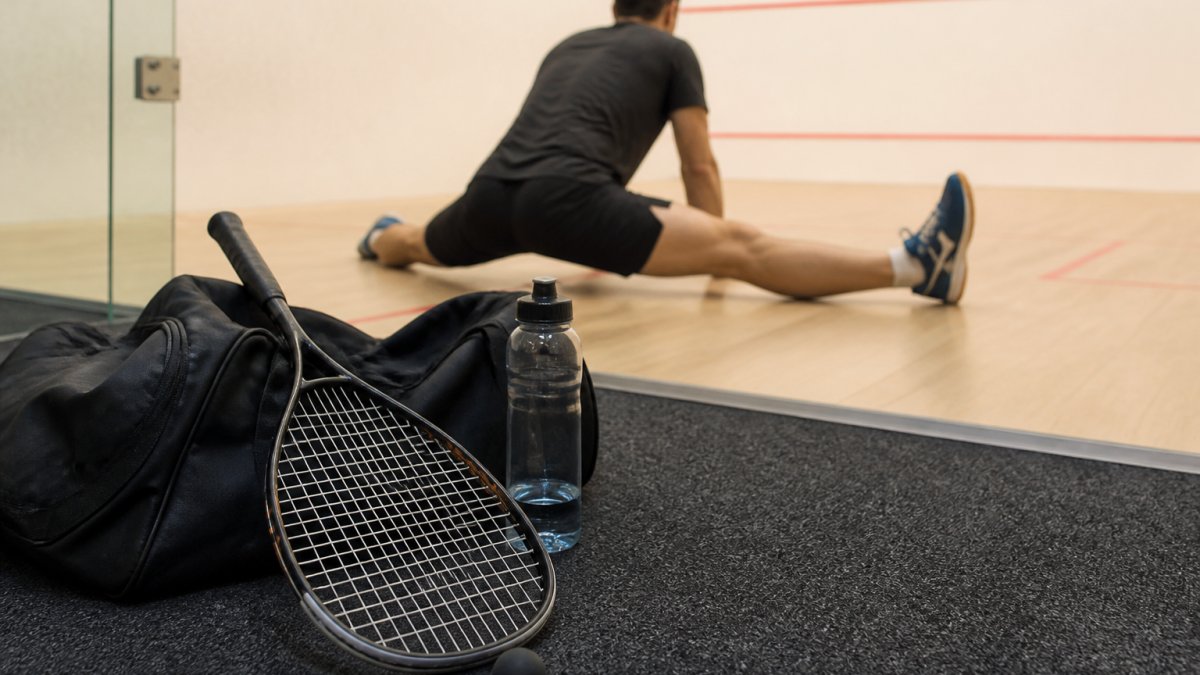
A water bottle and towel complete your kit. Racquetball is intense and you'll sweat. Staying hydrated keeps your performance steady and your focus sharp.
What to Bring to Your First Lesson
Arrive 15 minutes early to get comfortable with the court and meet your instructor.

Bring your own racquet and shoes if you have them, but most facilities loan equipment to beginners, arrive early enough to collect and adjust it.
Wear comfortable athletic clothing with full range of motion, cotton or moisture-wicking, nothing restrictive or heavy.
Bring a water bottle, preferably a litre or larger.
A towel is practical for wiping sweat from your face and hands between rallies. Sweaty hands reduce grip, and a quick wipe maintains your control.
Most importantly, bring an open mind.
Racquetball Drills for Beginners to Build Confidence
Drills isolate specific skills and build them in isolation before you apply them in live rallies. This approach accelerates learning and prevents bad habits from forming.
The wall drill is your foundation. Stand 2-3 metres from the front wall, hit the ball directly at it, let it bounce once, and hit again.
The side-wall drill teaches you to use the whole court.
The serve drill isolates your serve, which beginners often neglect.
The rally drill with an instructor or experienced player applies these skills. Start with slow, cooperative rallies aimed at consistency rather than winners, then increase pace as confidence grows.
Creating a Racquetball Practice Plan
Consistency beats intensity in racquetball. A structured practice plan keeps you progressing and prevents plateaus.
Schedule 2-3 court sessions per week if you're serious. One maintains basic skill, two accelerate improvement, three or more build real competency. Keep sessions to 45-60 minutes: 10-15 minutes of warm-up drills, 30-45 minutes of live play or instruction.
Alternate structured lessons and free play.
Track your progress informally. Notice which shots feel solid, which situations still frustrate you, and which opponents or playing styles challenge you most.
Vary your opponents. Playing the same person repeatedly means you adapt to their style and stop improving. Seek different levels and styles: someone slightly better accelerates learning, someone slightly worse reinforces fundamentals.
Set a simple goal for each session: "Today I'll focus on my serve," or "Today I'll move to the back wall faster." Specific goals keep your practice purposeful and prevent mindless hitting.
Booking Your First Session and Joining
Booking a beginner racquetball lesson is a two-part task: securing court time and securing a coach. Treat them separately, because at many venues they are booked through different channels.
Booking the court
Court booking is usually the simpler half. Most venues with racquetball-capable courts offer online booking through a web portal or smartphone app, with access via a key or code on arrival. At Launceston Squash Centre, courts can be booked through the centre's online booking system and accessed with a secure smartphone key, with hours from 6am to 11pm daily. Before your first visit, set up the app and test the booking flow on your phone so you are not learning the system at the door. Confirm two things when you book: that the court is marked for racquetball, and whether the booking includes equipment hire or is court-only.
Booking the coach
Coaching is rarely bookable through the same self-service portal. Expect to arrange it by phone or email with the venue, and expect the coach to confirm the time separately. When you make contact, give the coach the information they need to place you correctly:
Your experience level (complete beginner is fine, say so).
Any prior racquet-sport background (squash, tennis, badminton).
Your general fitness and any injury concerns.
Whether you want one-to-one or small-group instruction.
Your availability across a typical week.
Ask for the lesson duration, the cost per session, and whether a block of lessons is discounted. Ask what happens if you need to reschedule, and whether the coach supplies racquets and eyewear or expects you to bring your own. Get the answers in writing if you can, a short confirmation email removes ambiguity on the day.
Understanding the cost structure
Costs in this market typically break into three parts: court hire, coaching fee, and equipment hire. Court hire is usually charged per 45- or 60-minute block. Coaching is charged either per session or as a block of sessions, and a block is normally cheaper per session than paying casually. Equipment hire, where offered, is usually a small add-on per visit. Ask for each component separately rather than a single bundled figure, so you can see what you are paying for and compare venues fairly. If a venue quotes only a bundled price, ask them to break it down.
Watch Out Do not assume a court booking includes a coach. At most venues it does not. If you book a court expecting instruction and none arrives, you have paid for solo court time. Confirm the coaching booking separately and keep the confirmation.
Membership versus casual play
You do not need a full membership to try racquetball. Most venues offer casual per-session court hire, and some offer part-time or off-peak memberships for occasional players. Start casual for your first two or three sessions. If you are playing weekly and booking peak times, compare the casual cost over a month against the membership fee, the crossover point is usually reached quickly for regular players. Ask whether membership includes coaching discounts, because that can change the calculation.
If formal lessons are not available
If the venue cannot offer structured beginner lessons, book a court anyway and ask whether a staff coach can run a single introductory session. If not, book a court and use the first session to work through the wall drill and serve drill from the practice section of this guide. Many venues will also introduce a beginner to a regular player who is happy to hit with them, ask at the desk. This informal route is common in smaller markets and is a legitimate way to start.
Arriving for your first session
Arrive 15 minutes early. Use the time to collect any hired equipment, change into court shoes, and walk the court to get a sense of the walls and floor markings. Confirm with the desk that your coach booking is recorded. Rushing in stressed undermines the first session more than any technical weakness in your game.
Frequently Asked Questions
How do beginners learn to play racquetball?
Beginners learn racquetball through structured lessons with a coach who teaches grip, footwork, and basic strokes. Most lessons start with wall drills to build confidence before playing against an opponent. Group or individual sessions are available depending on your preference. Practising regularly between lessons accelerates your progress and helps you apply what you've learned.
What are the basic rules of racquetball?
In racquetball, players take turns hitting a ball against the front wall using a racquet. The ball must hit the front wall before bouncing on the floor more than once. Players alternate serves, and a point is scored when your opponent fails to return the ball or breaks a rule. Matches are typically played to 15 points, and you must win by at least 2 points.
How long does it take to learn the basics of racquetball?
Most beginners grasp the fundamentals within 4-6 weeks of regular lessons and practice. You'll learn basic strokes, court positioning, and scoring rules relatively quickly. However, developing consistency and competitive skills takes several months of dedicated practice. The timeline depends on how frequently you play and practise between lessons.
How do I book a beginner racquetball lesson?
Contact Launceston Squash Centre to enquire about current lesson availability, coach schedules, and pricing. You can book court time online, and membership options are flexible.
Book Online
Add launcestonsquash.com.au as a preferred source on Google →

Comments