
Why Squash Is a Great Social Sport for Adults
Table of Contents
Why Squash Is a Great Social Sport for Adults
The 'Third Place' You've Been Missing
How Squash Builds Community and Social Connection
Post-Match Social Rituals That Keep Players Coming Back
The Physical Health Benefits of Squash for Adults
Why the Workout Suits Adult Bodies
The Fitness Benefits That Actually Transfer to Daily Life
Agility, Flexibility, and Hand-Eye Coordination
The Social Multiplier on Physical Health
How Long Does It Take to Get Back Into Squash Fitness?
Beginner Squash Tips for Adults Joining a Club
What to Expect on Your First Visit
How to Actually Meet People at a Club
Overcoming Social Anxiety in Sports
The Technical Basics Worth Learning First
Equipment and Barrier-to-Entry Breakdown
How to Join a Social Squash Community Near You
Frequently Asked Questions
Last Updated: September 23, 2026
Why Squash Is a Great Social Sport for Adults
Squash is one of the few sports where you get a serious workout and a real conversation in the same hour.
The 'Third Place' You've Been Missing
Sociologists talk about the "third place", a spot that isn't home or work, where people gather casually and repeatedly. Pubs, churches, and community halls used to fill that role. For many adults today, nothing does.
How Squash Builds Community and Social Connection
Squash builds community faster than most adult sports because the format forces interaction. You can't hide in a crowd of twenty on a team bench. It's you, one other person, and a shared wall for 40 minutes.

Post-Match Social Rituals That Keep Players Coming Back
The handshake at the end of a match is only the start. What happens next is what builds the club.
Common rituals include:
Grabbing a drink or a coffee after the game
Comparing notes on shots, racquets, and tactics
Booking the next session before you leave
Chatting with whoever's waiting for the court after you
Pro Tip Book your next match before you leave the court. Players who lock in a follow-up session on the spot are far more likely to actually turn up than those who say "I'll text you."
The Physical Health Benefits of Squash for Adults
Most squash articles sell the workout, and it's a serious one. But for a social sport, the fitness keeps you showing up and the social commitment keeps you fit, the two reinforce each other in a way a gym membership never quite manages.
Why the Workout Suits Adult Bodies
Squash is a stop-start sport: a typical social rally lasts 15 to 30 seconds, followed by a similar rest while you retrieve the ball and reset. That interval pattern is why adults who hate steady-state cardio tolerate squash well.
Sprung wooden floors. Most purpose-built courts use a suspended floor that flexes slightly under impact, absorbing some of the load that would otherwise travel up through your ankles, knees, and hips.
Short court dimensions. You're rarely sprinting more than a few metres, so the repeated acceleration and deceleration is contained rather than extreme.
Walls as brakes. You don't have to decelerate from full speed in open space. The court geometry naturally limits how far you can overrun a shot.
The Fitness Benefits That Actually Transfer to Daily Life
Generic benefit lists are easy to ignore. What matters is what changes in the rest of your week.
What Squash Trains | The Everyday Payoff |
Repeated short bursts of high heart rate | Better stamina for stairs, hills, and chasing kids |
Lateral lunging and direction changes | Stronger hips and ankles, fewer tweaks on uneven ground |
Rotational core work on every swing | Less lower-back stiffness from desk work |
Tracking a fast ball into corners | Sharper reaction time when driving or catching things |
40 minutes of focused movement | A genuine mental reset, not just physical tiredness |
Agility, Flexibility, and Hand-Eye Coordination
Squash sharpens agility, flexibility, and hand-eye coordination because every rally demands quick direction changes and precise timing. You're reacting to a ball moving at speed, often into corners, often off the side wall.
Over time, players notice:
Faster reflexes and quicker footwork
Better balance and body control
Improved reach and range of motion
Sharper tracking of fast-moving objects
The Social Multiplier on Physical Health
This is the part most fitness content skips. Adults who train alone rely on willpower; adults who train with a regular partner have a social obligation, and social obligation is a far more reliable motivator than discipline.
Pro Tip If you're using squash primarily for fitness, aim for two sessions a week with at least one day between them. That gives your joints and connective tissue time to adapt, which matters more for adults than for juniors.
How Long Does It Take to Get Back Into Squash Fitness?
Most adults returning after a long break feel reasonably comfortable within four to six weeks of playing twice a week. Full match fitness, five games without fading, usually takes two to three months.
A sensible return looks like this:
Weeks 1-2: Play 30-minute sessions, focus on movement and clean contact
Weeks 3-4: Extend to 40 minutes, add short bursts of intensity
Weeks 5-6: Play full games, monitor recovery between sessions
Weeks 7-12: Build toward full match play and longer rallies
Beginner Squash Tips for Adults Joining a Club
The fastest way to enjoy squash as an adult beginner is to accept you'll be bad for a while and that nobody at the club cares. Everyone started somewhere.
What to Expect on Your First Visit
Walking into a squash club for the first time is a specific kind of awkward, you don't know where to change, where to wait, or whether to introduce yourself. Here's the reality:
Most clubs are quiet during the day and busy from about 5pm to 9pm on weeknights. If you want a low-pressure first session, book a mid-morning or early-afternoon court.
Reception may be unstaffed. Many clubs now run on online booking and smartphone entry, so you may not see a person at all until you're on court.
The change rooms are usually straightforward. Bring a towel, a water bottle, and non-marking shoes. Most clubs have showers.
Nobody will watch you play. Courts are enclosed. The only person paying attention to your game is your opponent.
How to Actually Meet People at a Club
This determines whether you stick with squash or quietly stop going after three weeks. The sport is easy to enjoy; the community keeps you coming back.
A few approaches that work:
Ask the club to pair you with a beginner-friendly player. Most clubs keep a list of members happy to hit with newcomers. This is the single fastest way in.
Join an internal ladder or house league. These are graded, so you'll be matched against people at your level. They're structured, low-stakes, and designed to introduce members to each other.
Turn up to social nights even if you don't have a partner. Social nights exist precisely so that unpaired players can find a game.
Book the next session before you leave. This is the habit that turns a one-off visit into a routine.
Say yes to the post-match drink or coffee. The court is where you meet people. The ten minutes afterwards is where you become friends.
Overcoming Social Anxiety in Sports
Walking into a new club alone is genuinely uncomfortable for many adults. That feeling doesn't mean you're not a "sporty person", it means you're human.
What helps:
Book a court at a quieter time for your first visit
Ask the club to pair you with a beginner-friendly player
Arrive early, watch a game, get a feel for the place
Tell people you're new. Most players will go out of their way to help
Remember that every regular in that club was once the new person standing awkwardly by the door
The Technical Basics Worth Learning First
Once the social side is sorted, a little technical grounding makes the game more enjoyable:
Learn the service box and the tin. These two rules cover most of what confuses beginners in the first game.
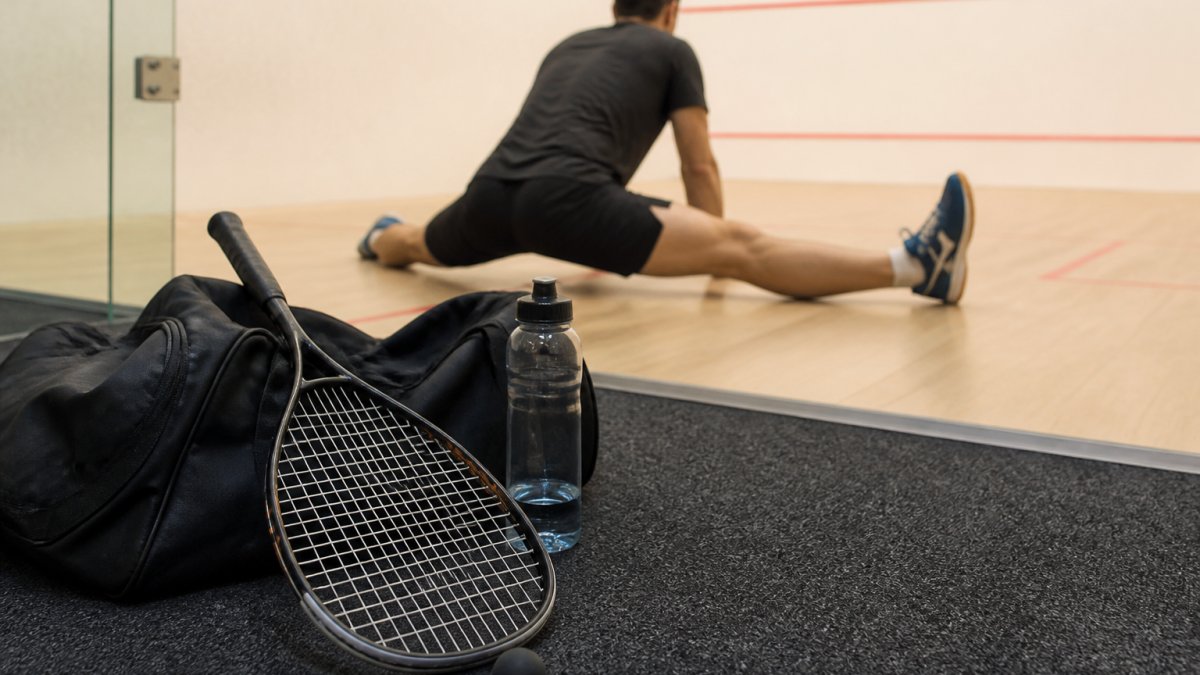
Warm up properly, including ankles, hips, and shoulders.
Play with people at a similar level, not the club champion.
Focus on getting to the ball early rather than hitting hard.
Book shorter sessions at first, then build up.
Watch Out Don't skip the warm-up to "save time." Cold muscles plus sudden lunging is the most common way adult beginners pull a calf or roll an ankle in their first month.
Key Takeaway The goal of your first month isn't to improve your game. It's to find one or two people you enjoy playing with. Everything else, the fitness, the skill, the routine, follows from that.
Equipment and Barrier-to-Entry Breakdown
Getting started with squash costs far less than most people assume: a racquet, a ball, court shoes, and a booking. That's it.
Here's what each piece actually involves:
Item | What to Look For | Typical Price Range |
Racquet | Lightweight frame, medium head size | From around $90 |
Ball | Single-dot for social play, double-dot for advanced | Around $8 per ball |
Court shoes | Non-marking sole, lateral support | From around $120 |
Eyeguards | Impact-rated, comfortable fit | Low cost, often club-supplied |
Membership | Casual or frequent-play options | Varies by club |
How to Join a Social Squash Community Near You
A practical path:
Find a local club and check its operating hours and booking system
Book a casual session at a time that suits you, even if it's early morning or late evening
Ask about social nights or internal ladders where you can meet players at your level
Play a few casual games before committing to any membership
Lock in a regular slot once you find people you click with
Key Takeaway The single biggest predictor of whether an adult sticks with squash isn't fitness or skill. It's whether they've got one or two regular playing partners. Find those first, and everything else follows.
If you're unsure where to start, the Australian Sports Commission's club finder can point you toward registered clubs and programs in your area.
Frequently Asked Questions
Is squash suitable for adults who are new to racquet sports?
Squash is beginner-friendly and welcomes adults of all skill levels. The rules are straightforward, and you can start with modified versions like mini-squash to build confidence. Many clubs offer introductory sessions and social nights specifically for newcomers. The key is choosing the right ball for your level (a blue or red dot ball bounces more and is easier to hit) and focusing on having fun rather than perfect technique. Social squash is about enjoying the game and meeting people.
How does squash compare to other social sports for building community?
Squash offers a unique combination of intense physical activity and genuine social interaction. Unlike team sports where you might only interact with teammates, squash naturally pairs you with different opponents each week. The close-knit nature of club culture means you quickly learn names and develop friendly rivalries. Post-match drinks and club social events are common, creating a strong sense of belonging. The sport's year-round playability also means consistent social contact, unlike seasonal sports.
What are the primary health benefits of playing squash for adults?
Squash delivers a full-body workout that improves cardiovascular fitness, agility, flexibility, and hand-eye coordination. A typical session burns significant calories and builds endurance. The sport also supports mental health by providing stress relief and social connection. Because it's a high-impact sport, wearing proper court shoes and warming up thoroughly is important for injury prevention.
How can I find social squash opportunities in my local area?
Start by contacting local squash centres and asking about social leagues, club nights, or casual match play. Platforms can list local leagues and allow you to register as an individual player, often pairing you with others at similar skill levels. Many centres also run beginner-friendly social sessions where the focus is on fun and fitness rather than competition. Visiting a club and speaking to staff or members is often the quickest way to find the right group for you.
The hardest part of any social sport isn't the game. It's the first booking. Once you're on court, the rest tends to sort itself out.
Launceston Squash Centre makes that first step easy, with online booking, self-service access through the SALTO app, and hours that run from 6am to 11pm every day. Whether you want a casual hit once a month or a regular weekly match, there's a membership option that fits.
Get started with Launceston Squash Centre and find your next regular playing partner.
Book Online

Comments