
Squash Training Drills: 7 Solo and Partner Sessions
Table of Contents
Squash Training Drills That Build Real Match Skills
What to Bring and How to Warm Up Before You Start
Squash Drills for Beginners: Start With These Five
Technique Cues for the Forehand and Backhand
Solo Squash Drills You Can Run on Any Court
No Court? Adapt These Drills at Home
Squash Partner Drills: Boast and Drive Combinations
How to Build a Squash Training Session Plan
20-Minute Session (Time-Poor or Beginner)
30-Minute Session (Intermediate)
60-Minute Session (Advanced or Match Preparation)
How to Progress Between Plans
How to Track Improvement Over Time
Common Mistakes to Avoid in Squash Training Drills
Conclusion: Turning Drills Into Results
Frequently Asked Questions
Last Updated: October 13, 2026
Squash Training Drills That Build Real Match Skills
Squash training drills are structured, repeatable hitting patterns that build the shots, footwork and decision-making you need in a match. They work because repetition trains your body to move before your brain catches up. This guide breaks down sessions you can run alone or with a partner, from your first week on court to match-ready combinations.
Most players plateau because they rally instead of drilling. A rally is fun. A drill has a target, a score and a purpose. Below, we'll show you exactly how to run both, with clear targets and progressions.
Here's what most guides get wrong: they list shots without telling you how many, how long, or what "good" looks like. We'll fix that.
What to Bring and How to Warm Up Before You Start
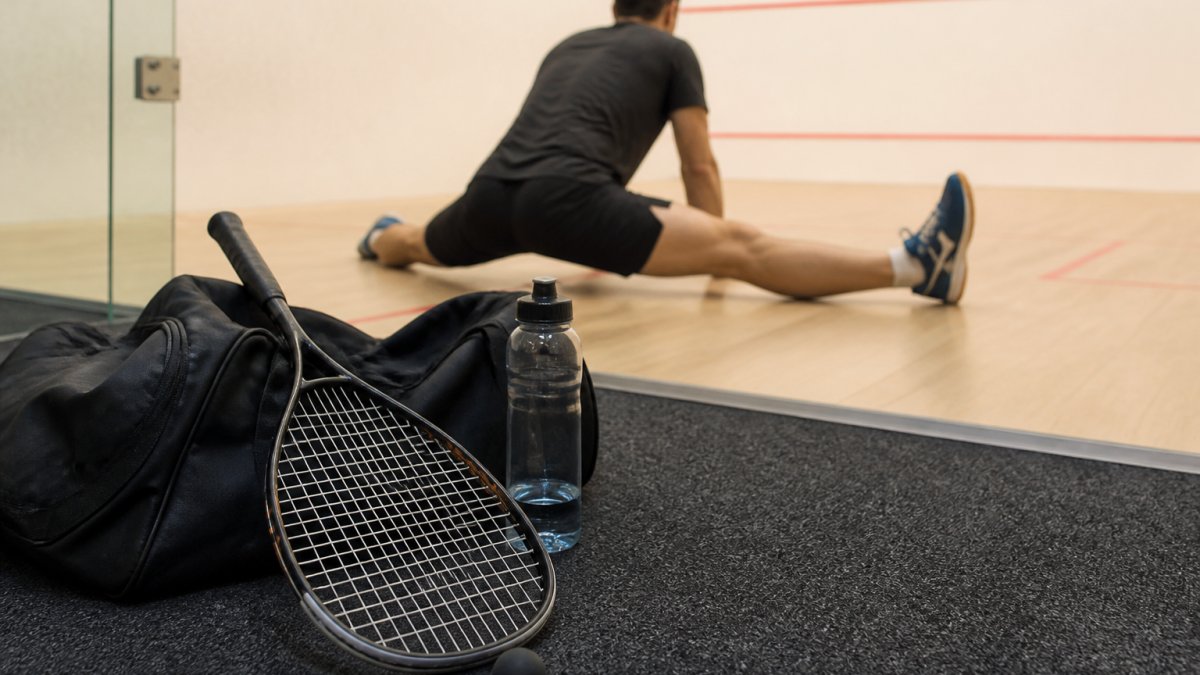
Bring a racquet, two balls, non-marking shoes, water and a towel. That's it. A basket of balls helps for solo work but isn't essential.
Warm up for five to eight minutes before you hit a single drive:
Jog two court lengths, then side-shuffle the width twice
Ten arm circles each way, then ten torso twists
Twenty light heel raises and ten bodyweight squats
Five minutes of gentle straight drives at half pace
Cold muscles and sudden lunges are how ankles roll. Five minutes of prep protects your session.
Watch Out Skipping the warm-up is a common mistake. Pulled calves and rolled ankles can happen in the first ten minutes of a cold session, not at the end when you're tired.
Squash Drills for Beginners: Start With These Five
Beginners should master five drills before anything else: straight drives, backhand drives, service returns, court movement and simple volleys. Get these right and every other shot gets easier.
Josh Attwell Sports
For all five, use a target the size of a shoebox in the back corner. It does not need to be a real marker, just a consistent spot in your head. Score every set out of ten and write the number down.
1. Straight Drive Ladder Stand mid-court, drop the ball and drive it straight to the front wall so it lands in the back quarter on your side. Hit ten, count how many land in the target zone, rest 60 seconds, repeat for five sets.
2. Backhand Mirror Drill Same setup and scoring as the ladder, on the backhand side. Most beginners score two to three lower here, which is normal, the point is to give the weaker side equal reps, not to match your forehand immediately.
3. Service Return Reps Stand on the T. A partner serves twenty times to a mix of heights and paces. Your job is a controlled return to the back corner, not a winner.
4. T-to-Corner Movement From the T, move to one corner, shadow a shot, and return to the T. Ten reps per corner, all four corners, timed. Record your total time and aim to beat it next session.
5. Basic Volley Catch Hit the ball to yourself off the front wall and volley it back before it bounces. Start with ten in a row. If you lose control, reset the count.
Pro Tip Run these five as a circuit when you are short on time: one set of each, 90 seconds rest between drills, repeated twice. That is a complete 25-minute beginner session with a score for every drill.
Technique Cues for the Forehand and Backhand
Keep your wrist firm and your racquet head up on the backswing. Turn your shoulders early, step into the ball, and follow through toward your target. On the backhand, lead with your non-playing hand for balance. Watch the ball onto the strings, not the wall.
Three cues that fix the most common beginner errors:
Racquet preparation: if you are late, your backswing is too long, not too slow. Shorten it and turn your shoulders earlier.
Spacing: if you are jammed, you have moved too close to the ball. Aim to strike it a racquet-length away from your body.
Recovery: if you are always stretching for the next shot, you are watching your own shot instead of moving back to the T. Recover first, watch second.
Solo Squash Drills You Can Run on Any Court
Solo squash drills are the fastest way to improve because you get every rep. No waiting, no partner, no excuses.

The Drive-Drop Combo Hit a straight drive, then a drop shot to the same corner. Alternate ten times per side. This trains the exact shot pattern you'll use to move an opponent.
The Boast and Drive From the back corner, play a boast off the side wall, then a straight drive. Twenty reps. It builds recovery footwork as much as shot skill.
Continuous Hitting Set a timer for three minutes. Hit straight drives without stopping. Count your total. Beat it next session.
Crosscourt Drive Sets Ten crosscourt drives to the opposite back corner, then ten straight. Alternate.
Pro Tip Aim for a target the size of a shoebox in the back corner. Players who train with a small target improve their accuracy far faster than those who just "hit the wall." The target doesn't need to be real, just consistent in your head.
No Court? Adapt These Drills at Home
No court access? You can still train. Shadow swings build muscle memory, and a small ball against a garage wall or brick wall works for drives. Use a low-bounce ball indoors to protect furniture. Focus on footwork patterns: the split step, the lunge, and the recovery to the T.
Squash Partner Drills: Boast and Drive Combinations
Partner drills add pressure and realism that solo work can't copy. One player feeds, the other works. Swap places every five minutes.
Drill | What It Trains | Reps | Swap |
Boast and drive | Recovery footwork | 20 each | Every 5 min |
Drive and drop | Shot selection | 15 each | Every 5 min |
Crosscourt volley rally | Reflexes and control | Continuous | Every 3 min |
Conditioned game to 7 | Match pressure | Full game | Each game |
Boast and Drive Player A plays a boast, Player B drives straight. Keep the rally going. This builds the exact movement pattern of a real exchange.
Drive and Drop One player drives, the other drops, then swap roles mid-rally. It forces quick decisions about shot selection.
Conditioned Games Play a game to seven where you can only score off a drop shot. It sharpens patience and court positioning.
How to Build a Squash Training Session Plan
A good squash training session plan has four parts: warm-up, technical block, combination block, conditioned play, and cool-down. The structure stays the same at every level, what changes is the length, the intensity and the ratio of drilling to playing. Pick one focus per session. Trying to fix everything at once fixes nothing.
Here are three plans by session length and ability, so you can start at the right level and move up when the numbers tell you to.
20-Minute Session (Time-Poor or Beginner)
Warm-up (4 min): jog two court lengths, side-shuffle the width twice, ten arm circles each way, five minutes of gentle straight drives at half pace.
Technical block (6 min): one shot only, straight drives or backhand drives. Three sets of ten, score each set.
Combination block (6 min): drive-drop combo, ten reps per side.
Cool-down (4 min): easy movement and stretching.
Use this when you can only get on court twice a week.
30-Minute Session (Intermediate)
Warm-up (5 min): as above, plus ten light volleys.
Technical block (8 min): one shot drilled hard with a target and a score.
Combination block (8 min): two shots linked, such as boast-and-drive or drive-and-drop.
Conditioned play (6 min): a game to seven with a rule that forces the shot you just drilled.
Cool-down (3 min): easy movement and stretching.
60-Minute Session (Advanced or Match Preparation)
Warm-up (8 min): movement and light hitting, building to full pace.
Technical block (15 min): one shot, drilled hard, with a success target you have to beat.
Combination block (15 min): two shots linked, at match pace.
Conditioned play (15 min): games with rules, including one game where you can only score off the shot you drilled.
Cool-down (7 min): easy movement and stretching.
How to Progress Between Plans
Move up a level when you hit the success criteria at your current one, not when you feel ready. A simple rule: if you can complete the technical block at 70 per cent accuracy or better for three sessions in a row, add five minutes and one more block. If your accuracy drops below half, drop back a level for a week.
How to Track Improvement Over Time
Track three things: reps completed, targets hit, and how you felt. A simple notebook works. Note the date, the drill, and the score.
Straight drives landing in target: aim to increase weekly
Continuous hitting streak: aim to beat your last number
Recovery time between rallies: aim to shorten it
Session completion: note whether you finished the plan or ran out of time
Small, steady gains beat one big session. If your numbers stall for three weeks, change the drill, not the goal.
Watch Out Do not jump from a 20-minute plan to a 60-minute plan in one week. A sharp rise in niggles, calves, ankles and shoulders, can occur when weekly court time doubles. Add five to ten minutes per week instead.
Common Mistakes to Avoid in Squash Training Drills
The biggest mistake is drilling without a target. If every shot counts as a success, you learn nothing. Set a zone and score it.
Other frequent errors:
Hitting too hard instead of too accurately
Skipping the backhand because it feels bad
Training for two hours once a week instead of four short sessions
Ignoring footwork and only practising shots
Never swapping roles in partner drills
Key Takeaway Accuracy can be more effective than power. A controlled straight drive that lands in the back corner can win more points than a hard shot that hits the tin.
Conclusion: Turning Drills Into Results
The hard part isn't knowing these drills. It's showing up and doing them when nobody's watching. Pick two from this list, run them twice a week for a month, and track your numbers.
At Launceston Squash Centre, we make that easy. Book a court online, get in with your secure smartphone key through the SALTO app, and play any time between 6am and 11pm. Flexible memberships suit casual players and regulars alike.
Get started with Launceston Squash Centre and turn your squash training drills into real match results.
Frequently Asked Questions
Can I learn squash by myself?
Yes. Solo squash drills cover most of the basics: straight drives, crosscourt drives, boasts and drop shots. You can practise alone on any court, with or without a partner, as long as you have a racquet, a ball and a target. Start with 20-minute sessions, focus on one shot type at a time, and measure how many balls you can hit consistently before errors creep in. Many players build solid technique this way before joining club nights.
What are the best solo squash drills for beginners?
Start with straight drives to the front wall, aiming for a consistent height and length. Add crosscourt drives once straight drives feel steady, then move to boast and drive combinations. Finish with ghosting through the T to build footwork and recovery. A simple plan is 10 minutes of straight drives, 10 minutes of crosscourt drives, 5 minutes of boasts and 5 minutes of ghosting, repeated three times a week.
How long should a squash training session last?
Most club-level sessions run 45 to 60 minutes, including a 5 to 10 minute warm-up and a short cool-down. Beginners can get useful work done in 30 minutes if they focus on one or two shot types. If you are training for competition, extend to 75 minutes and split the time between drills, conditioned games and ghosting. Consistency across the week matters more than one long session.
How do you practise squash with a partner?
Use partner drills that force both players to move and recover. Boast and drive is a good starting point: one player boasts, the other drives straight, then swap. Add drop shot and drive rallies, crosscourt volleys and conditioned games where only certain shots score. Rotate roles every few minutes so both players work on attack and defence, and keep a count of unforced errors to track progress.
Book Online


Comments