
Return to Squash: A 7-Step Guide to Playing Again
Updated: Sep 16
Table of Contents
Assess Your Current Fitness and Health
Build a Squash Fitness Training Plan
Refresh Your Technique and Court Movement
Solo Hitting and Practice Drills
Warming Up On Court
Squash Injury Prevention Tips for Returning Players
Choose the Right Equipment and Racket
Gradual Return to Match Play
Low Impact Exercise Alternatives to Squash
Find Training Partners and Get Started
Last Updated: August 29, 2026
Assess Your Current Fitness and Health
Before returning to court, get an honest picture of your current fitness. If you've been away from squash for years, your cardiovascular capacity, muscle strength, and court-specific conditioning have all declined. Start from your actual baseline, not where you used to be.
Talk to your GP about returning to a high-intensity sport, especially if you're over 40 or have any history of joint issues, heart concerns, or previous injuries (the NHS). A simple check-up takes an hour and gives you real data on what you can safely handle.
Test your aerobic capacity with a 12-minute walk-run test on a flat surface. How far can you cover without stopping? That number tells you whether you're starting from a "sedentary" or "moderately active" baseline. Squash demands both aerobic endurance and anaerobic threshold work, the ability to sustain intense bursts.
Check your flexibility and mobility. Can you touch your toes? Rotate your shoulders fully? Squat without your heels lifting? Tight hamstrings, stiff hip flexors, and limited ankle mobility are common culprits behind returning-player injuries. If you're tight, you'll need dedicated stretching work alongside your squash training.
Be realistic about your starting point. If you haven't played in five years, you're starting fresh. Accuracy keeps you injury-free.
Build a Squash Fitness Training Plan
Your fitness plan needs to rebuild three things in this order: aerobic base, then strength and stability, then court-specific power.
Weeks 1-3: Aerobic Foundation
Start with 20-30 minutes of low-impact aerobic work three times per week, walking, cycling, or swimming at 60-70% of your maximum heart rate (the CDC). This raises your aerobic capacity without taxing your joints. Most returning players skip this and jump straight to intensity, which is how they end up sidelined.
Weeks 4-6: Add Strength Work
Add two sessions per week of bodyweight strength: squats, lunges, push-ups, and planks. These build the muscular foundation that supports court movement. Twenty minutes of focused strength work twice weekly is enough to build resilience for rapid direction changes and explosive starts.
Weeks 7-8: Introduce Court Movement Drills
Before you play matches, reintroduce your body to court-specific movement patterns. Ghosting, moving through the court without hitting the ball, is the bridge between fitness and game play. Start with 10 minutes of ghosting at moderate intensity.
Ongoing: Match Your Intensity to Your Recovery
Monitor how you feel 24-48 hours after training (peer-reviewed research). Mild soreness is normal. Sharp pain, persistent swelling, or fatigue that doesn't improve with rest is a signal to dial back. If you're tired, you're not recovering. If you're not recovering, you're not getting stronger.
Refresh Your Technique and Court Movement
Your technique hasn't disappeared, but it's rusty. The muscle memory is still there, it just needs reactivation. Poor technique burns energy and invites injury. Good technique does both jobs at once.

Solo Hitting and Practice Drills
Solo hitting is your best friend when returning to squash. Start with 15-20 minutes of solo hitting twice per week, focusing on rhythm and consistency rather than power. Hit the ball cleanly and repeatedly to groove the basic shots: drives, boasts, and cross-court hits.
A boast is a shot hit to the side wall first, then the front wall. Practice boasts from different court positions, 10 from the back left, then 10 from the back right. This builds court awareness and footwork without match pressure.
Cross-court drives are diagonal shots that open up the court. Hit 20 cross-court drives from the back of the court, focusing on depth and control. Once comfortable, add a volley, hitting the ball before it bounces.
Practice drills are structured. A simple one: hit a drive to the back corner, move to the T (center court), and reset. Repeat for 10 shots. This teaches court movement and recovery.
Warming Up On Court
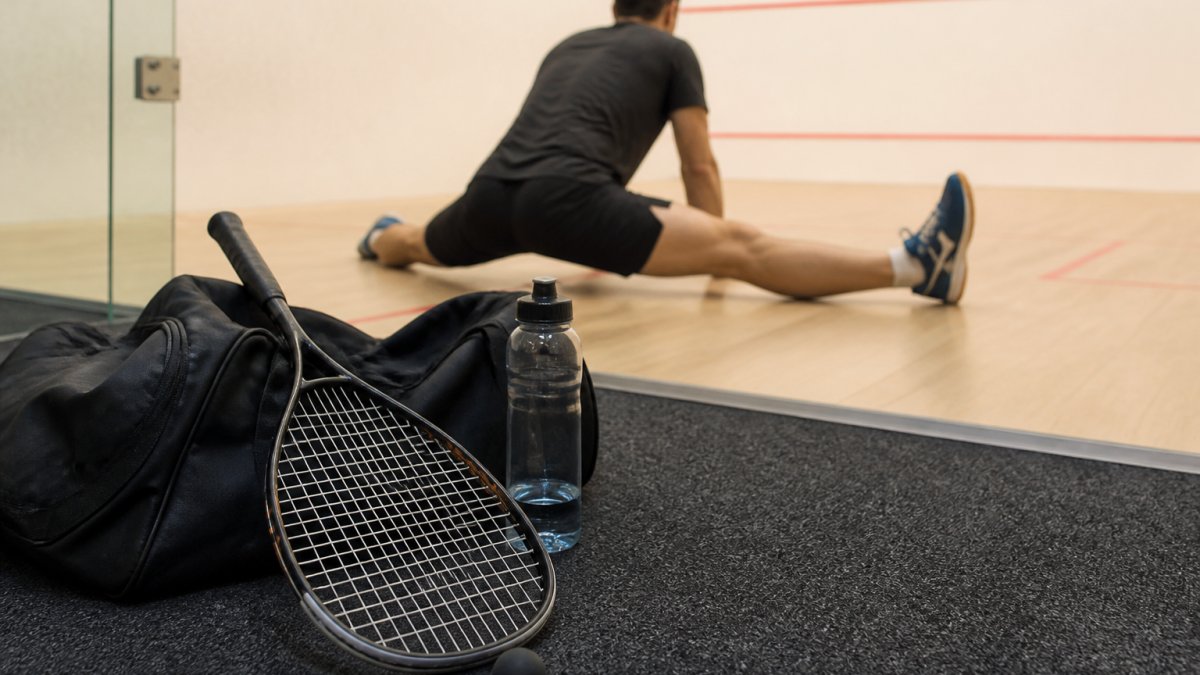
Your warm-up is injury prevention and performance preparation combined. Spend 10 minutes warming up before every session.
Start with 3 minutes of light movement: jog gently around the court, do arm circles, and mobilise your hips and ankles. Then hit easy balls against the front wall for 5 minutes at 50% intensity. After 5 minutes of easy hitting, do 2 minutes of dynamic stretching: leg swings, walking lunges, and torso rotations.
By the time you're ready to train hard, your body is prepared and injury risk is reduced.
Squash Injury Prevention Tips for Returning Players
Returning players are at higher injury risk than players who never stopped. Your tissues are deconditioned, your movement patterns are rusty, and you're likely impatient. Prevention is simpler than recovery.

Strengthen Your Ankles and Knees
Squash is a lateral sport with rapid direction changes. Weak ankles and knees will give way or develop pain. Spend 10 minutes twice per week on ankle and knee stability work: single-leg balance exercises, lateral lunges, and calf raises.
Stretch Your Hip Flexors and Hamstrings
Tight hip flexors limit your range of motion and force your lower back to compensate. Spend 5 minutes daily stretching these areas. Lie on your back, pull one knee toward your chest, and hold for 30 seconds. Repeat on the other side. Then do a standing forward fold, holding for 60 seconds.
Monitor Your Shoulder and Rotator Cuff
The repetitive overhead motion of serving and hitting can irritate the rotator cuff. If you feel shoulder pain, stop. Do rotator cuff strengthening: external rotations with a light resistance band, 15 reps, three times per week.
Pace Your Return
You can't return to match play intensity immediately. Your tissues need time to adapt. Take two weeks of solo hitting and drills before you play your first match. Then play one match per week for the first month, gradually increasing frequency as your body adapts.
Choose the Right Equipment and Racket
Don't use your old racket. Modern rackets are lighter, more forgiving, and generate more power with less effort. A light racket with a larger head gives you more margin for error on off-centre hits.
For a returning player, forgiveness matters more than spin. Ask the staff at a local squash facility about racket recommendations.
Wear court shoes, not running shoes. Court shoes have lateral support and a non-marking sole. Running shoes are designed for forward motion. Squash is lateral. The wrong shoes increase your injury risk and reduce your control.
Gradual Return to Match Play
Match play is different from solo hitting or drills. Your opponent doesn't cooperate. The ball comes at you unpredictably. Your heart rate spikes. This is why you can't jump straight into matches.
Your first match should be against a beginner or friend who'll keep the pace moderate. Ask them to rally rather than compete. A rally is a cooperative exchange where both players hit the ball back and forth without trying to win the point.
Play one match per week for the first month at 70% of your maximum effort. You should be able to talk between rallies. After four weeks of moderate-intensity matches, you can gradually increase intensity and frequency.
Monitor your body after each match. Mild soreness is expected. Sharp pain, swelling, or pain that worsens over 48 hours is a signal to rest and assess.
Low Impact Exercise Alternatives to Squash
Some returning players discover they have joint issues that make squash difficult. Others want to supplement their squash training with lower-impact work.
Swimming builds cardiovascular fitness and muscular endurance without loading your joints. Thirty minutes of steady swimming twice per week complements squash training well.
Cycling builds leg strength and aerobic capacity with minimal impact. Yoga improves flexibility, balance, and body awareness. Walking maintains aerobic fitness and costs nothing.
Find Training Partners and Get Started
Solo hitting and drills build your foundation, but squash is a sport played against an opponent. Finding the right training partners matters.
Look for players at your level or slightly above. A player much better than you will frustrate you. A player much worse will bore you. A player at your level or slightly above challenges you without overwhelming you.
Ask at your local facility about beginner groups or social nights. Most squash centres run these regularly for players returning to the sport or learning for the first time.
At Launceston Squash Centre, we've created flexible access specifically for returning players. Our online booking system and extended hours, 6am to 11pm daily, mean you can train at times that suit your schedule. The self-service access via the SALTO app on your smartphone removes friction. You book a court, you show up, you play.
Start with one session per week. Solo hitting or a drill session with a friend. Build consistency before you add intensity or frequency. After two weeks, add a second session. After four weeks, you'll have a routine. After eight weeks, you'll feel like a squash player again.
Your first few weeks back are foundational. Train smart, be patient with yourself, and focus on consistency over intensity. The game will still be there in six months. The question is whether you'll be ready to play it well, or whether you'll be nursing an injury that could have been prevented.
Frequently Asked Questions
How can I safely return to squash after a long break?
Start with a fitness assessment and medical check if you have any concerns. Begin with solo hitting and gentle drills at low intensity, focusing on technique and footwork before match play. Gradually increase court time over 4-6 weeks, mixing conditioning work with on-court practice. Warm up thoroughly, stretch daily, and listen to your body. Avoid high-intensity matches until you've rebuilt your aerobic capacity and muscle memory.
What squash fitness training plan should I follow when restarting?
Combine three elements: aerobic conditioning (steady-state cardio 3 times weekly), court-specific drills (footwork, ghosting, and solo hitting 2-3 times weekly), and strength work targeting your legs, core, and shoulders. Progress intensity gradually, rushing this phase increases injury risk significantly.
What squash injury prevention tips should I prioritize?
Prioritise dynamic stretching before play and static stretching after. Strengthen your ankles, knees, and core to handle rapid direction changes and explosive movements. Wear proper court shoes with lateral support. Warm up on court for at least 10 minutes before drilling or playing. Monitor your recovery, rest days are as important as training days. If you experience sharp pain, stop immediately. Build intensity gradually to allow your connective tissues to adapt. Consider low-impact cross-training on rest days to maintain fitness without court stress.
Are there low impact exercise alternatives to squash I can use alongside my return?
Yes. Swimming builds aerobic capacity and shoulder strength without joint impact. Cycling improves leg endurance and aerobic fitness. Pilates and yoga enhance flexibility, balance, and core stability, all critical for court movement. Rowing develops full-body conditioning. Elliptical training offers cardio without the impact of running. These alternatives are ideal for active recovery days and help prevent overuse injuries. Rotating squash with one or two low-impact sessions weekly accelerates your safe return without overloading your joints.
Returning to squash is achievable at any age when you approach it systematically. Start with a fitness assessment, build your aerobic base before adding intensity, refresh your technique through solo hitting and drills, and protect yourself from injury through gradual progression and smart conditioning. The sport you love hasn't changed. You have. Respect that, train accordingly, and you'll be back where you belong.
Book Online
This article was written using GrandRanker


Comments