
Cheap Squash Court Access vs Premium Memberships (2026)
Table of Contents
Cheap Squash Court Access vs Premium Memberships: The 2026 Comparison
Casual Squash Court Hire Rates: What You Pay Per Session
Racquetball Court Access in Northern Tasmania: How On-Demand Booking Works
What Premium Memberships Actually Include
Calculating Your Break-Even Point
The Hidden Cost of Staying Non-Member
Hybrid Access Models: Pay-Per-Play Meets Membership
Which Option Fits Your Playing Frequency?
Frequently Asked Questions
Last Updated: September 22, 2026
Cheap Squash Court Access vs Premium Memberships: The 2026 Comparison
Squash court access is the arrangement that determines how, when, and how often you can book a court, whether that's a casual pay-per-session booking or an annual membership. At Launceston Squash Centre, we've watched players wrestle with one question more than any other: is cheap casual court hire actually cheaper than a premium membership? The honest answer is that it depends on how often you play. Below, we'll show you exactly how to work out your own break-even point, including the hidden costs most players never factor in.
Casual Squash Court Hire Rates: What You Pay Per Session
Casual squash court hire rates are the per-session fees you pay when you book a court without any membership commitment. You pay for the session, you play, and you walk away with no recurring cost.
The trade-off is real. Per-session pricing gives you total flexibility, but the rate per game is almost always higher than what a member pays. If you play once a month, that premium buys you freedom. If you play three times a week, you're subsidising the membership you should probably have.
Most facilities structure casual access around peak and off-peak windows. Peak hour rates apply after work and on weekends, when demand is highest. Off-peak sessions, usually mid-morning and late evening, are priced lower to fill quiet courts. Booking systems make this visible upfront, so you can see the session cost before you commit.
Pro Tip If you're a casual player, book off-peak where you can. The same court, the same 40 minutes, a lower session cost, and far better court availability.
Racquetball Court Access in Northern Tasmania: How On-Demand Booking Works
Racquetball court access in northern Tasmania has shifted from phone calls and paper diaries to online booking systems that run around the clock. On-demand access means you reserve a court when it suits you, not when a reception desk happens to be staffed.
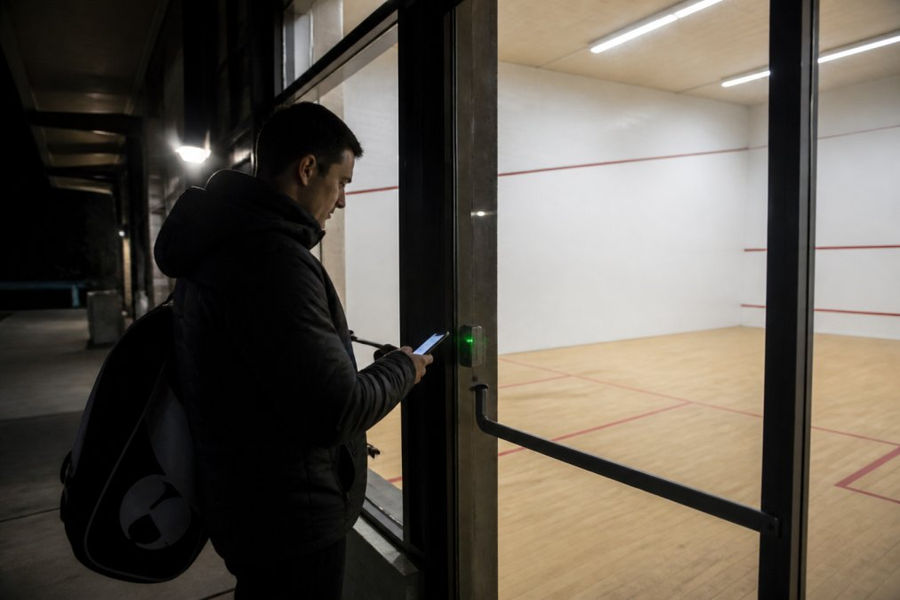
Launceston Squash Centre runs this model across extended hours, from 6am to 11pm daily. You book online, then enter using a secure smartphone key through the SALTO app. No keys to collect, no waiting for someone to unlock a door.
For shift workers, this is the difference between playing and not playing. A court at 6am or 10pm is genuinely available, not just advertised. If you're coming from a facility where access depended on staffed hours, expect the booking process itself to feel unfamiliar for the first week. After that, it's faster than a phone call ever was.
What Premium Memberships Actually Include
Premium membership is a recurring subscription that bundles court access with additional inclusions, usually at a lower effective cost per session than casual hire. What sits inside that bundle varies enormously between facilities.
A typical premium membership includes unlimited play, priority court reservation windows, member discounts on coaching, and access to club fixtures and social squash nights. Some bundle in fitness classes or gym access. Others add tournament entry at reduced rates.
Membership Type | What You Get | Best For |
Casual per-session | Court hire only, no commitment | Occasional players, once or twice a month |
Standard membership | Discounted sessions, booking priority | Regular weekly players |
Premium membership | Unlimited play, fixtures, member discounts | Frequent players, competitive training |
Bundled fitness membership | Squash plus gym and fitness classes | Players who train across multiple activities |
The inclusions matter more than the headline rate. A membership that throws in unlimited play but no social fixtures may suit a solo trainer and frustrate someone who wants a club community. Read the inclusions list before you compare monthly fees.
Calculating Your Break-Even Point
Your break-even point is the number of sessions per month at which a membership costs the same as paying casually. Above it, the membership wins. Below it, casual access does. The maths is simple, but the inputs are where most players go wrong.
The basic formula:
Break-even sessions = Monthly membership fee ÷ Casual session cost
If a membership costs $80 a month and casual sessions run $20 each, your break-even is four sessions. Play five times and the membership is cheaper. Play twice and you've overpaid.
But that formula assumes every casual session costs the same. In reality, most facilities charge different rates for peak and off-peak. If you play a mix, say two peak sessions at $24 and two off-peak at $16, your average casual cost is $20, and the break-even stays at four. If you play only peak, your break-even drops to 3.3 sessions (round up to four). If you play only off-peak, it rises to five. Run the numbers on your actual booking pattern, not a flat rate.
Worked example: three player profiles
Player | Monthly play | Casual cost per session | Monthly casual total | Membership fee | Break-even sessions | Verdict |
Casual | 2 | $22 | $44 | $85 | 3.9 | Casual wins |
Regular | 6 | $22 | $132 | $85 | 3.9 | Membership wins |
Hybrid candidate | 3 | $22 | $66 | $85 | 3.9 | Casual wins, but hybrid may suit |
Adjusting for what's included
A membership that includes coaching discounts, free fixtures, or gym access is not the same product as a bare court hire. To compare fairly, subtract the value of the inclusions you'll actually use from the membership fee before dividing.
The frequency trap
Key Takeaway If you play two to four times a month and your schedule shifts week to week, a hybrid tier usually beats both extremes. You get member pricing without paying for unlimited play you won't use.
The Hidden Cost of Staying Non-Member
Staying non-member isn't free. It just moves the cost somewhere less visible.
Hybrid Access Models: Pay-Per-Play Meets Membership
Hybrid access is the middle path: a membership tier that includes a set number of sessions per month, with casual rates for anything beyond that. It suits players whose schedule doesn't fit neatly into "casual" or "committed".
Common hybrid structures
Punch card: Buy a block of 10 sessions upfront at a discount, then book them whenever you like. No expiry, no monthly fee. Effective per-session cost typically sits between casual and membership rates.
Multi-visit pass: A monthly or quarterly pass that covers a set number of sessions (e.g., eight per month) at a fixed price. Unused sessions usually don't roll over, so it rewards regular play.
Off-peak membership: Unlimited play but restricted to off-peak hours. Cheaper than a full membership, but useless if you can only play after work.
Flexi-membership: A lower monthly fee that includes booking priority and member discounts, but you still pay a reduced casual rate per session. Best for players who want the perks without the commitment.
How to compare a hybrid tier
The peak-hour catch
Pro Tip If you're considering a hybrid tier, ask the club for a trial month or a single punch card first. It's the cheapest way to test whether the structure matches your actual playing pattern.
Which Option Fits Your Playing Frequency?
Playing frequency decides this, and nothing else comes close. Here's the short version:
Once or twice a month: casual court hire. You'll never hit break-even on a membership.
Weekly: a standard membership usually pays for itself, especially with booking priority.
Three or more times a week: premium or unlimited membership, without question.
Irregular or shift-based: hybrid access, or a facility with genuine 24-hour-style on-demand booking.
Frequently Asked Questions
Is squash expensive to play compared with other sports?
Squash sits in the middle of the pack. Casual court hire and a shared racquet cost far less per session than golf or skiing, and the equipment lasts years. Premium memberships push the annual cost closer to a mid-tier gym subscription, but they include unlimited play. The real variable is how often you play: once a month, casual access wins; twice a week, a membership usually pays for itself.
How does pay-as-you-go squash court access compare to a monthly subscription?
Pay-as-you-go means you only pay when you step on court, so a quiet month costs nothing. A monthly subscription spreads the cost evenly and rewards regular play with unlimited or heavily discounted sessions. Work out your average sessions per month, multiply by the casual squash court hire rate, and compare that figure to the subscription fee. If the casual total is higher, the subscription is the better deal.
Are there hidden costs in squash memberships?
Some memberships exclude competition entry, coaching, or guest passes, so those become add-ons. Others lock you into a minimum term with exit fees. Before signing, ask what is included in the monthly fee, whether peak-hour bookings cost extra, and what the cancellation notice period is. A membership that looks cheap per week can cost more once league fees and tournament entries are added.
How often should you play to justify a premium membership?
Use a simple break-even calculation. Divide the annual membership cost by the casual squash court hire rate to get the number of sessions needed to match it. If that number is below your realistic yearly play count, the membership is worth it. Most regular players who book two or more sessions a week hit break-even within a few months, while once-a-fortnight players rarely do.
What are the benefits of a dedicated squash club membership?
Beyond court time, a club membership usually includes access to fixtures, social squash nights, coaching clinics, and a ready pool of playing partners. Those extras matter if you want structured competition or a regular hit. Casual access gives you the court but not the community, so if the social side of the sport is what keeps you coming back, a membership delivers more than just cheaper sessions.
Book Online


Comments